
The Titanic sails at dawn - politics, economics & culture
Saturday, December 24, 2011
"The Big Lie"
More debunking of the fraudulent "Fannie and Freddie caused the mortgage meltdown" line coming out of Amerian Enterprise Institute and other desperate right-wing noisemakers, by Joe Nocera HERE.


Thursday, December 22, 2011
The 10 worst economic ideas of 2011
Jeff Madrick at Roosevelt Institute:
Let’s hope the New Year brings some new ideas, because this year’s couldn’t have been much worse — or more widespread.
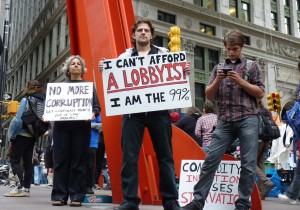
I was at an Occupy Wall Street demonstration this weekend and many clergy addressed the group. One nun told the crowd it was Christmas season and that it was time for something new to be born in America.
It was a nice thought, and I hope that the “something new” is good sense, because it has been a year in which some of the worst economic ideas ever have gained support and are being applied around the world. So here’s my list of the 10 worst economic ideas of 2011:
Top ten from the dumb and dumber...
1. Taxes should be more regressive.
At the top of the list for sheer scandalous insensitivity are Herman Cain’s and New Gingrich’s tax plans for America. Cain and Gingrich are both flat tax advocates. Cain proposes “9-9-9″ — a 9 percent sales tax, 9 percent income tax, and 9 percent corporate tax. He would also eliminate most deductions. Would this raise more or less money? The romantic conservatives claim the lower income tax rate would mean more growth. Never mind that the evidence to support that claim has been found profoundly lacking time and again.

The Payroll Tax Cut Extension - GOP holds recovery hostage
 |
| Be careful where you point your gun... |
Congress has not been able to agree on extending the payroll tax cut, and as it stands, payroll taxes will increase in January. What impact will this gridlock have on the economy? What about the expiration of unemployment benefits, another effect of the failure to produce legislation on the payroll tax cut?
The payroll tax cut amounts to around $1,000 per year for the typical household, which adds up to a around $120 billion per year in additional purchasing power for the total workforce. If the payroll tax cut is not extended when Congress reconvenes, losing that much purchasing power would make an already slow recovery even slower...
Wednesday, December 21, 2011
"No, Conservatives, the Bush Recession Did Not Alleviate Economic Inequality"
Winning Progressive takes on some recent right-wing push-back and misdirection as the issue of income inequality gains resonance with the American public:
Showing how out of touch they are with everyday Americans, conservatives have latched
onto the news that the share of national income taken in by the top 1% fell from 23% in 2007 to “only” 17% in 2009 to contend that the focus of Occupy Wall Street and others on economic inequality is somehow misguided. For example, in a post titled “The 1% Ain’t What It Used To Be,” conservative blogger Megan McCardle responded that “we don’t want to spend years focused on income inequality, only to learn that the financial crisis fixed it for us.” Conservative economics professor Steven Kaplan of the University of Chicago business school echoed such doubts and actually offered a defense of inequality, stating in the New York Times that:
“It’s very interesting that [inequality] has become such a big topic now when the numbers are back to where they were in the 1990s,” said Steven Kaplan, an economist at the University of Chicago’s business school. “People didn’t seem to be complaining about it then.”
Pointing to the recent declines at the top, Mr. Kaplan argues the Occupy protesters have accused the wrong villain by focusing on inequality, which he called an inevitable byproduct of growth. “If you want to reduce inequality, all you need to do is put the economy in a recession,” he said. “If you want the economy to do well, as all of us do, then you’ll get more inequality.”Kaplan’s effort to link growth and economic inequality as inherently related is historically incorrect. For example, from 1950 to 1980, the share of income taken by the top 1% remained below 12% in all but one year, and was below 10% in 13 of those years. During that same time period, the US economy experience virtually uninterrupted growth. When the economy dipped in the early 1980s, the share of income taken by the top 1% increased. While it is true that most recessions lead to a decline in the share of income for the top 1%, the historical record does not support the contention that economic inequality is the inevitable byproduct of growth. In addition, while some level of inequality may be necessary for economic growth, elevated levels of inequality – such as those in the US today - actually stunt economic growth.
Monday, December 19, 2011
"Tax inequality"

An interesting, innovative idea for tax policy to stem the rising tide of income inequality, from law professors Aaron Edlin and Ian Ayres, HERE.
Sunday, December 18, 2011
Krugman on GOP Monetary Madness
Ron Paul's crank Gold Buggery is the new GOP "mainstream." Paul Krugman describes the descent into madness:
Mr. Paul identifies himself as a believer in “Austrian” economics — a doctrine that it goes without saying rejects John Maynard Keynes but is almost equally vehement in rejecting the ideas of Milton Friedman. For Austrians see “fiat money,” money that is just printed without being backed by gold, as the root of all economic evil, which means that they fiercely oppose the kind of monetary expansion Friedman claimed could have prevented the Great Depression — and which was actually carried out by Ben Bernanke this time around.
O.K., a brief digression: the Federal Reserve doesn’t actually print money (the Treasury does that). But the Fed does control the “monetary base,” the sum of bank reserves and currency in circulation. So when people talk about Mr. Bernanke printing money, what they really mean is that the Fed expanded the monetary base.
And there has, indeed, been a huge expansion of the monetary base. After Lehman Brothers fell, the Fed began lending large sums to banks as well as buying a wide range of other assets, in a (successful) attempt to stabilize financial markets, in the process adding large amounts to bank reserves. In the fall of 2010, the Fed began another round of purchases, in a less successful attempt to boost economic growth. The combined effect of these actions was that the monetary base more than tripled in size.

Austrians, and for that matter many right-leaning economists, were sure about what would happen as a result: There would be devastating inflation. One popular Austrian commentator who has advised Mr. Paul, Peter Schiff, even warned (on Glenn Beck’s TV show) of the possibility of Zimbabwe-style hyperinflation in the near future.
So here we are, three years later. How’s it going? Inflation has fluctuated, but, at the end of the day, consumer prices have risen just 4.5 percent, meaning an average annual inflation rate of only 1.5 percent. Who could have predicted that printing so much money would cause so little inflation? Well, I could. And did. And so did others who understood the Keynesian economics Mr. Paul reviles. But Mr. Paul’s supporters continue to claim, somehow, that he has been right about everything.
Thursday, December 15, 2011
The GOP candidates' plan to wreck the economy
Tim Dickinson at Rolling Stone on the GOP "Crazy":
 |
| The Little Rascals |
While threatening to slash the safety net for millions of Americans, the GOP candidates are also committed to a brutal austerity program that would tip the nation back into recession – if not a full-scale depression. The proposal in question is a constitutional amendment that would require the federal government to pass a balanced budget each year.Read Dickinson's complete "The GOP's Crackpot Agenda" HERE.
According to Macroeconomic Advisers, a top economic forecaster, balancing the budget in 2012 alone would throw 15 million Americans out of work, double unemployment to 18 percent and contract the U.S. economy by 17 percent. Going forward, the government would be barred from borrowing money during hard times to provide unemployment benefits, food stamps and other essential aid to those in need. As a result, the analysts report, "recessions would be deeper and longer." Even in times of plenty, a balanced-budget amendment would "retard economic growth" by increasing economic uncertainty – which Republicans have repeatedly blamed as the root of the current lackluster recovery.
Wednesday, December 14, 2011
The roots and the depth of the Great Recession
World-class economist Joseph Stiglitz has an essential essay in Vanity Fair, in which he uses new research and insights into the causes of the Great Depression to suggest that we need a fundamental rethinking of how to tackle the current crisis:
Stiglitz' analysis and conclusions are too important to simply excerpt or summarize. Read his entire piece HERE.The trauma we’re experiencing right now resembles the trauma we experienced 80 years ago, during the Great Depression, and it has been brought on by an analogous set of circumstances. Then, as now, we faced a breakdown of the banking system. But then, as now, the breakdown of the banking system was in part a consequence of deeper problems. Even if we correctly respond to the trauma—the failures of the financial sector—it will take a decade or more to achieve full recovery. Under the best of conditions, we will endure a Long Slump. If we respond incorrectly, as we have been, the Long Slump will last even longer, and the parallel with the Depression will take on a tragic new dimension.
Until now, the Depression was the last time in American history that unemployment exceeded 8 percent four years after the onset of recession. And never in the last 60 years has economic output been barely greater, four years after a recession, than it was before the recession started. The percentage of the civilian population at work has fallen by twice as much as in any post-World War II downturn. Not surprisingly, economists have begun to reflect on the similarities and differences between our Long Slump and the Great Depression. Extracting the right lessons is not easy.

Tuesday, December 13, 2011
The awfulness cont. - Newt's tax plan
Unfortunately we have to review the noxious stuff that spews forth from Newt Gingrich. Robert Reich has the latest here:
Newt Gingrich has done it again. With his new tax plan he has raised the bar from irresponsibility to recklessness.
Every dollar estimate I’m about to share with you comes from the independent, non-partisan Tax Policy Center – a group whose estimates are used by almost everyone in Washington regardless of political persuasion.
First off, Newt’s plan increases the federal budget deficit by about $850 billion – in a single year!

"Do as I say, not as I do..."
James Suroweicki on the default double-standard for mortgage-holders and corporations:
We normally say that a company “went bankrupt,” implying that it had no choice. But when, recently, American Airlines filed for bankruptcy, it did so deliberately. The airline had four billion dollars in the bank and could have kept paying its bills. But it has been losing money for a while, and its board decided that it was foolish to keep throwing good money after bad. Declaring bankruptcy will trim American’s debt load and allow it to break its union contracts, so that it can slim down and cut costs.
American wasn’t stigmatized for the move. Instead, analysts hailed it as “very smart.” It is now generally accepted that when it’s economically irrational for a company to keep paying its debts it will try to renegotiate them or, failing that, default. For creditors, that’s just the price of business. But when it comes to another set of borrowers the norms are very different. The bursting of the housing bubble has left millions of homeowners across the country owing more than their homes are worth. In some areas, well over half of mortgages are underwater, many so deeply that people owe forty or fifty per cent more than the value of their homes. In other words, a good percentage of Americans are in much the same position as American Airlines: they can still pay their debts, but doing so is like setting a pile of money on fire every month.
These people have no hope of ever making a return on their investment in their homes. So for many of them the rational solution would be a “strategic default”—walking away from the mortgage and letting the bank take the house. Yet the vast majority of underwater borrowers keep faithfully paying their mortgages; studies suggest that perhaps only a quarter of all foreclosures are strategic. Given how much housing prices have fallen, the question is why more people aren’t just walking away.

Sunday, December 11, 2011
Tales of Income Inequality
 Think Progress:
Income inequality in the U.S. is currently the highest its been since the 1920s, with the 400 richest Americans (who are all billionaires) having as much wealth as the bottom 50 percent of Americans combined. And as it turns out, just one wealthy family has managed to amass a fortune equal to that of the combined net worth of the bottom 30 percent of Americans — the Waltons, heirs to the Walmart fortune...
Saturday, December 10, 2011
The Foreclosure Crisis
Chris Hayes on the foreclosure "tsunami" and appropriate response:
Visit msnbc.com for breaking news, world news, and news about the economy
Friday, December 9, 2011
More true facts - the empirical evidence suggests that cutting top marginal tax rates on the rich increases non-productive income inequality rather than economic growth
Dan Buecke at Bloomberg:
This should get Grover Norquist up off the couch: a paper by a prominent team of economists says the tax rate for top U.S. earners could be hiked to 83 percent without hurting anyone but the “mega rich.” And in what’s sure to add gasoline to the income-inequality debate, they suggest pay increases for the wealthiest few reflect mostly “rent seeking” — econo-speak for unshackled greed — rather than executive-suite productivity improvements.
Thomas Piketty of the Paris School of Economics, Emmanuel Saez of Berkeley and Stefanie Stantcheva of MIT reach those conclusions after disputing that tax cuts in several countries since the 1970s had any real impact on per-capita GDP growth. As they say in their less wonky summary (hat tip to 3 Quarks Daily)... “countries that made large cuts in top tax rates such as the United Kingdom or the United States have not grown significantly faster than countries that did not, such as Germany or Denmark.”

What does show a strong correlation is falling tax rates and the share of pre-tax income held by the top 1 percent — doubled in the U.S., to more than 20 percent, over the past 40 years. (emphasis added)
True facts - "A larger welfare state can mean a lower deficit"
 |
| Robert Samuelson |
Speaking of things that the European crisis is not about (debt and deficits), while I was in Germany, my colleague Robert Samuelson wrote that “Europe’s turmoil is more than a currency crisis and was inevitable, in some form, even if the euro had never been created. It’s ultimately a crisis of the welfare state, which has grown too large to be easily supported economically.”
I don’t think that quite works. Take Germany. They have a pretty big welfare state: pensions, health care, paid vacations, unemployment benefits equal to two-thirds of one’s income. Indeed, the Organization for Economic Cooperation and Development keeps track of social spending — unemployment, old-age pensions, health care, etc — as a percentage of GDP. In 2007, Germany spent 25.2 percent of their GDP on such things. Greece spent 21.3 percent on social policies. Yet Greece is in crisis, and Germany is fine.
To bring this across the Atlantic, you could argue that the United States’s debt burden is the product of an insufficiently large welfare state — at least with regard to health care.
"The Wrong Fix" for the Eurozone
Harold Myerson at The American Prospect:
(T)he deal that German Chancellor Angela Merkel and French President Nicolas Sarkozy struck to save the Eurozone will inflict years of austerity on European nations that are already mired in depression. Spain, for instance, has an unemployment rate of about 20 percent and a youth unemployment rate that is approaching a mind-boggling 50 percent. It needs a massive Keynesian jolt to its economy, not budgetary constraints that will condemn it to a decade or quarter-century of penury...

(T)he Merkel-Sarokzy solution was based on a misdiagnosis of Europe’s woes. Some of Europe’s current basket cases were actually running budget surpluses in the years before the Lehman meltdown. Ireland and Spain weren’t overspending at all—but the banks and investors speculating on their housing markets most certainly were. When their banks went under, their economies collapsed, driving their unemployment rates, and their budget deficits, sky-high. If Ireland and Spain could do it over again, they’d have adopted far tighter bank regulations—something that the Merkel-Sarkozy deal doesn’t call for...
Thursday, December 8, 2011
Why we can't have nice things...

Between 2008 and 2010, 30 large corporations spent more on lobbying Washington than they spent on taxes. Details here, via ThinkProgress.
General Electric, of course, tops the list.
Tuesday, December 6, 2011
Obama in Osawatomie - the matter of Kansas and renewing populism
Today President Obama went on the offensive in Osawatomie, Kansas. His speech struck some welcome populist chords. Osawatomie is a historic town - best known to historians for the Battle of Osawatomie, which in 1856 was an early skirmish in what eventually became the Civil War. In the "Bloody Kansas" warfare over the eventual fate of the territory as a "free state", pro-slavery forces attacked the town - being defended by the radical abolitionist John Brown - and burned it to the ground.
In 1910 progressive Republican Theodore Roosevelt gave a notable speech in Osawatomie, focusing on the dangers of economic concentration and the corruption of politics by corporate money. TR's "money quote":

In 1910 progressive Republican Theodore Roosevelt gave a notable speech in Osawatomie, focusing on the dangers of economic concentration and the corruption of politics by corporate money. TR's "money quote":

At many stages in the advance of humanity, this conflict between the men who possess more than they have earned and the men who have earned more than they possess is the central condition of progress. In our day it appears as the struggle of freemen to gain and hold the right of self-government as against the special interests, who twist the methods of free government into machinery for defeating the popular will. At every stage, and under all circumstances, the essence of the struggle is to equalize opportunity, destroy privilege, and give to the life and citizenship of every individual the highest possible value both to himself and to the commonwealth.Here's President Obama's message from Osawatomie, which reclaimed some of Teddy Roosevelt's populist narrative:
(F)or most Americans, the basic bargain that made this country great has eroded. Long before the recession hit, hard work stopped paying off for too many people. Fewer and fewer of the folks who contributed to the success of our economy actually benefitted from that success. Those at the very top grew wealthier from their incomes and investments than ever before. But everyone else struggled with costs that were growing and paychecks that weren’t – and too many families found themselves racking up more and more debt just to keep up.

Monday, December 5, 2011
The "Job Creator"
The LA Times unpacks the "Mitt" Myth of Willard M. Romney as an entrepreneurial business man comitted to "job creation":


Shortly after Mitt Romney resigned from Bain Capital in 1999 to run the Olympics in Salt Lake City, potential investors received a prospectus touting the extraordinary profits earned by the private equity firm that Romney controlled for 15 years.
During that time, Boston-based Bain acquired more than 115 companies, according to the prospectus. Bain's estimated annual returns were more than five times that of the Dow Jones Industrial Average in the same period.
Now a front-runner for the Republican presidential nomination, Romney says his Bain experience shows he knows how to create jobs. He often cites Bain's investment in a little-known office supply store called Staples, which now employs more than 90,000 worldwide.
But a closer examination of the prospectus paints a different picture of Bain's operation. Under Romney's leadership, Bain became one of the nation's top leveraged-buyout firms, helping lead a trend in which companies were acquired using debt often pledged against their own assets or earnings.
Sunday, December 4, 2011
Newt Gingrich - a man utterly dishonest and corrupt, driven by ignorance, shamelessness and unfettered self-regard
New York Times columnist Charles Blow examines the latest iteration of Newt Gingrich's awfulness:
Newt Gingrich has reached a new low, and that is hard for him to do.
"I am now a famous person. I represent real power."
Nearly two weeks after claiming that child labor laws are “truly stupid” and implying that poor children should be put to work as janitors in their schools, he now claims that poor children don’t understand work unless they’re doing something illegal.
On Thursday, at a campaign stop in Iowa, the former House speaker said, “Start with the following two facts: Really poor children in really poor neighborhoods have no habits of working and have nobody around them who works. So they literally have no habit of showing up on Monday. They have no habit of staying all day. They have no habit of ‘I do this and you give me cash’ unless it’s illegal.” (His second “fact” was that every first generational person he knew started work early.)
This statement isn’t only cruel and, broadly speaking, incorrect, it’s mind-numbingly tone-deaf at a time when poverty is rising in this country. He comes across as a callous Dickensian character in his attitude toward America’s most vulnerable — our poor children. This is the kind of statement that shines light on the soul of a man and shows how dark it is.

Subscribe to:
Posts (Atom)