
More people watched President Obama's jobs speech Thursday evening than tuned into the NFL's season kickoff game that followed.
Via Balloon Juice

The Titanic sails at dawn - politics, economics & culture
Here’s (Zandi's) projected impact of GDP and jobs:
–President Obama’s jobs proposal would help stabilize confidence and keep the U.S. from sliding back into recession.–The plan would add 2 percentage points to GDP growth next year, add 1.9 million jobs, and cut the unemployment rate by a percentage point.
Source: Zandi, Moody’s Analytics
I was favorably surprised by the new Obama jobs plan, which is significantly bolder and better than I expected. It’s not nearly as bold as the plan I’d want in an ideal world. But if it actually became law, it would probably make a significant dent in unemployment.
Of course, it isn’t likely to become law, thanks to G.O.P. opposition. Nor is anything else likely to happen that will do much to help the 14 million Americans out of work. And that is both a tragedy and an outrage...
(I)t’s worth noting just how much that opposition has hardened over time, even as the plight of the unemployed has worsened.

 |
| "We're all Bozos on this bus!" |
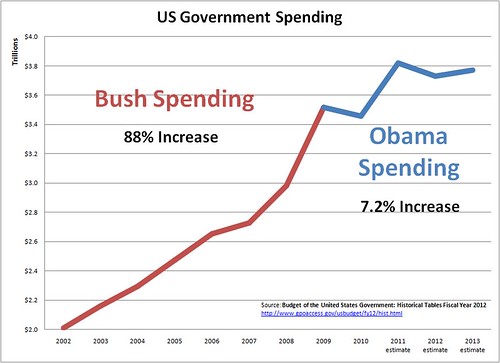
Jared Bernstein notes that if he's elected president, Mitt Romney has promised to "immediately move to cut spending and cap it at 20 percent of GDP." That's crazy with the economy so sluggish, but in fact, it's even crazier than that. Here are budget projections for 2013 from the OMB:

President Obama will lay out his latest jobs plan before a joint session of Congress on Thursday, in the wake of a report that showed zero net jobs were created last month. Unemployment has remained above 9 percent, while unemployment amongst African Americans is at a 27-year high...
But while the GOP may be firmly against progressive job creation measures, the public is assuredly not. According to two polls released today, the public supports government-backed measures to bring down the unemployment rate.
Republicans are predisposed to blame government for every problem regardless of the circumstances, and Democrats tend to view government as necessary to deal with economic and social problems...
Right now, it is clear that the right side of the political spectrum is dominant. Virtually all policy debate these days is based on the premise that the conservative position is at least valid. For example, we have heard for months from Republicans that government regulation is a major, if not the primary, factor holding back economic expansion and employment growth.
Just last week, the House majority leader, Eric Cantor of Virginia, posted a memo to House Republicans detailing specific regulations whose repeal would create jobs.


Let’s talk about the economics. Because the ozone decision is definitely a mistake on that front.

Barbara Stanwyck: "We're both rotten!"
Fred MacMurray: "Yeah - only you're a little more rotten." -"Double Indemnity" (1944)
Those lines of dialogue from a classic film noir sum up the state of the two political parties in contemporary America. Both parties are rotten - how could they not be, given the complete infestation of the political system by corporate money on a scale that now requires a presidential candidate to raise upwards of a billion dollars to be competitive in the general election? Both parties are captives to corporate loot. The main reason the Democrats' health care bill will be a budget buster once it fully phases in is the Democrats' rank capitulation to corporate interests - no single-payer system, in order to mollify the insurers; and no negotiation of drug prices, a craven surrender to Big Pharma.
But both parties are not rotten in quite the same way. The Democrats have their share of machine politicians, careerists, corporate bagmen, egomaniacs and kooks. Nothing, however, quite matches the modern GOP.

After more than a year of aggressive budget cutting by European governments, an economic slowdown on the continent is confronting policymakers from Madrid to Frankfurt with an uncomfortable question: Have they been addressing the wrong problem?
The campaign to reduce government deficits has come in response to a European debt crisis that could endanger the global banking system. And the budget cutting has been coupled with a reluctance by the the European Central Bank to stimulate economic growth like the Federal Reserve has in the United States; the ECB has instead raised interest rates twice this year to contain inflation.
Those steps have sucked hundreds of billions of dollars out of a European economy that may be edging towards recession.
The federal agency that oversees the mortgage giants Fannie Mae and Freddie Mac is set to file suits against more than a dozen big banks, accusing them of misrepresenting the quality of mortgage securities they assembled and sold at the height of the housing bubble, and seeking billions of dollars in compensation.
Texas Gov. Rick Perry (R) has built the early stages of his presidential campaign on his state’s ability to create jobs during the last two years of his governorship. The “Texas Miracle,” Perry often says, is responsible for 40 percent of the net new jobs created in America since June 2009. The “Miracle” is no miracle at all — Texas has the nation’s worst job creation record when adjusted for labor force growth — but Republican voters have lapped up the message, pushing Perry to a double-digit lead in early primary polls.

With all the stories about China dominating the solar photovoltaics (PV) manufacturing sector, you might not think that America is a net exporter of solar products. But it is — to the tune of $1.8 billion. That’s a $1 billion increase over net exports documented in the solar sector last year.
In fact, a report released this morning from GTM Research and the Solar Energy Industries Association found that the U.S. has a $247 million trade surplus with China.
U.S. imports in 2010 were estimated at $1.4 billion, while exports were estimated to be between $1.7 billion – $2.0 billion based on the availability of data for capital equipment sales. This made the U.S. a net exporter of solar goods to China by $247 million to $539 million. Imports came predominantly from modules ($1.2 billion), while exports were driven by capital equipment ($708 million to $1 billion) and polysilicon ($873 million).Solar isn’t just about the module. When looking at polysilicon production, equipment for manufacturing lines, power electronics, solar hot water tanks, and any number of other domestically-produced products, the U.S. actually offers a good-sized contribution to the global market.
The 2011 Solar Energy Trade Assessment is a follow up from last year’s report, which found U.S. net exports in 2009 were worth $723 million.
The $1 billion surge in net exports came during a year when the U.S. solar market grew by over 100%. Due to the successful Treasury Grant Program and Loan Guarantee Program that made it easier for developers and manufacturers to finance facilities, the solar sector grew faster than ever before.
And all that solar — particularly solar PV — brings immense value to the domestic economy.
 Ted Rall via Balloon Juice
There are 13.9 million unemployed people in the U.S. – and that just counts those looking for work. That works out to 9.1% of the labor force, the widely publicized unemployed rate.
But here are a few more ways to look at it.
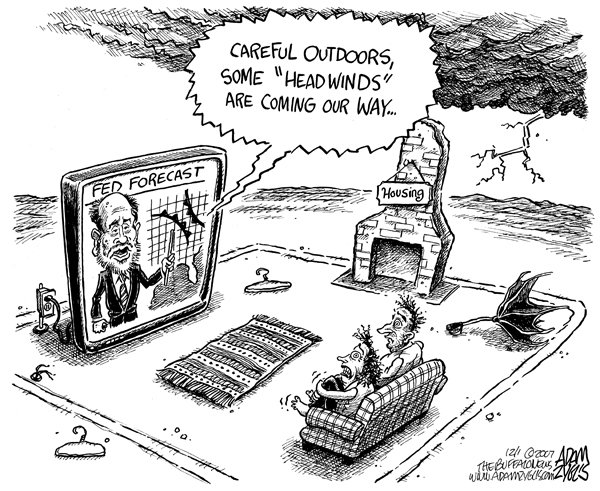
IF you were to conduct a survey of the country’s top economists, you would find a fair number who did not believe that the Federal Reserve should be taking more aggressive steps to help the economy. Some would worry that injecting more money into the economy might unnerve global investors or set off uncontrollable inflation. Others would wonder whether, with interest rates already so low, the Fed even had much power to lift economic growth.
But you would also find a sizable group of economists who thought the Fed could and should do far more than it was doing. This group, known as doves, tilts liberal, though it includes conservatives as well. If anything, it can probably claim a larger number of big-name economists — J. Bradford DeLong, Paul Krugman (an Op-Ed columnist for The New York Times), Christina D. Romer, Scott Sumner and Mark Thoma, among others — than the camp that believes the Fed has done too much.
You would never know this, however, from listening to the public debate among Federal Reserve officials. That debate is much narrower.


