Everyone's got a right to their own opinions…but not to their own facts.
When Republican presidential candidate Mitt Romney asserted that federal low-income programs are administered so inefficiently that “very little of the money that’s actually needed by those that really need help, those that can’t care for themselves, actually reaches them,” my colleagues at the CBPP got to work on this graph.
It shows that “federal administrative costs range from less than 1 percent to 8 percent of total federal program spending. Combined federal and state administrative costs range from 1 percent to 10 percent of total federal- and state-funded program spending.”
Gov Romney is singing from the same playbook as Rep Paul Ryan along with a litany of conservatives whose goal for years has been for the Federal gov’t to shed the responsibility for Medicaid, food stamps (SNAP), low-income housing, and so on. Once you “block grant” these functions to the states, it’s easier to cut them. And remember, this is from a candidate (and the same is true for the House R’s budget) that wants to cut taxes deeply for the richest households.
So he’s launching his attack based on inefficient administration—the claim that most of the dollars don’t reach the clients. Trouble is, the facts got in the way.
Many people argue that Gov Romney is the reasonable R candidate…you might not love his policies, they tell me, but he’s not known for making stuff up, for repeating outrageous statements with no basis in fact.
OK, let’s see—if he keeps repeating this falsehood, then they’re wrong.

The Titanic sails at dawn - politics, economics & culture
Friday, January 13, 2012
Mitt Romney's Crazy Talk III
Jared Bernstein has it:


Wednesday, January 11, 2012
The Man from Bain
The expose of Willard Mitt Romney's role as a job-killer with Bain Capital, currently being circulated - in the most ironic electoral gambit in my memory - by a pro-Gingrich "SuperPAC," funded to the tune of $5 million by a right-wing casino magnate and friend of Newt's.
![What do you think is the most important problem facing this country today? [OPEN-ENDED] January 2012 results](https://lh3.googleusercontent.com/blogger_img_proxy/AEn0k_veKH9QkegNjgczgau5oxm1KroXNi1mp1rWIKsSaKsJkwIHSZ1-OLafyscz8EZJdjblQrW7LGIznxE6Y3qlpeeB8Eh6Wc4si7NSTCuc94AT-uXzGdR1lqO7_SxmLgH91u3FAqDT1WxTBczykPet9-T9PSOrHqg43QYauzymG6QltUxt1yjIoblQH_5EliBSo9FkkIs=s0-d)
Tuesday, January 10, 2012
"The Foreclosure Crisis: A Government in Denial"
Bruce Judson at New Deal 2.0:
The financial crisis began with the housing crisis and it will not end until we resolve housing. Government policymakers who seemingly ignore this basic fact are leading the nation to another potential catastrophe.
This past week, a number of important events occurred in Washington, including important recess appointments by President Obama. However, the most noteworthy event did not make front page news: the Federal Reserve’s (apparently) unsolicited memo to the committees of Congress that oversee financial services warning of the dangers the current housing market poses for the economy.
This represents an extraordinary action and underscores both the seriousness of the continuing crisis and the absence of meaningful discussion of the problem in Washington. Bernanke’s memo reviewed federal actions to date and effectively concluded that they were unlikely to solve this national tragedy.
The memo concluded, in part:
The challenges faced by the U.S. housing market today reflect, in part…a persistent excess supply of homes on the market; and losses arising from an often costly and inefficient foreclosure process (and from problems in the current servicing model more generally)… Absent any policies to help bridge this gap, the adjustment process will take longer…pushing house prices lower and thereby prolonging the downward pressure on the wealth of current homeowners and the resultant drag on the economy at large.This memo is notable for several reasons. First, it’s important to remember that when the Fed speaks, it does so in sober, limited terms. So an unprompted Fed warning suggesting “a persistent excess of supply” and a “resultant drag on the economy” is comparable to the Secretary of Homeland Security holding a press conference to warn of the risk of an imminent national emergency. Second, an unprompted memo from Bernanke to the House means that he is so deeply worried he felt the need to speak out in as strong a voice as his position permits. Third, the Fed rarely speaks on issues unrelated to its direct activities. Indeed, The Wall Street Journal subsequently wrote, “For an institution that jealously guards its independence, the Federal Reserve is wading into treacherous political waters.”

Monday, January 9, 2012
Mitt Romney's Crazy Talk II
Anyone who believes Willard Mitt Romney is a moderate, thoughtful alternative to the cranks and crazies who populate the contemporary GOP - to, say, a Michelle Bachmann who will say anything, no matter how evidence-free or insanely hyperbolic - need go no farther than the following quote from Romney's current stump speech:
“President Obama believes that government should create equal outcomes. In an entitlement society, everyone receives the same or similar rewards, regardless of education, effort and willingness to take risk. That which is earned by some is redistributed to the others. And the only people who truly enjoy any real rewards are those who do the redistributing — the government.”
 Romney, in his desperation to get the top government job, has shape-shifted himself into an extremist as nutty and hysterical as the rest of them. He is explicitly claiming that President Obama is some sort of socialist who doesn't value education, entrepreneurial risk or work. This is an assertion, frankly, so far removed from the reality of President Obama's actual policies, his rhetoric and his values it doesn't deserve detailed refutation.
Anyone who believes this or asserts this absurdity demagogically isn't fit to teach a junior high school history or civics class, much less aspire to the highest office in the land. Romney brings shame on himself and his party, as much as the fringe characters like Donald Trump, Sarah Palin or Michelle Bachmann have with their "crazy talk."
(Paul Krugman also references this Romney nonsense in an excellent column today.)
“President Obama believes that government should create equal outcomes. In an entitlement society, everyone receives the same or similar rewards, regardless of education, effort and willingness to take risk. That which is earned by some is redistributed to the others. And the only people who truly enjoy any real rewards are those who do the redistributing — the government.”

Anyone who believes this or asserts this absurdity demagogically isn't fit to teach a junior high school history or civics class, much less aspire to the highest office in the land. Romney brings shame on himself and his party, as much as the fringe characters like Donald Trump, Sarah Palin or Michelle Bachmann have with their "crazy talk."
(Paul Krugman also references this Romney nonsense in an excellent column today.)
"How Austerity Is Killing Europe
Jeff Madrick at NYRB:
Read the rest of Madrick's excellent piece on the fallacy of austerity economics HERE."The European Union has become a vicious circle of burgeoning debt leading to radical austerity measures, which in turn further weaken economic conditions and result in calls for still more damaging cuts in government spending and higher taxes. The European debt crisis began with Greece, and that nation remains the European Union’s most stricken economy. But it has spread inexorably to Ireland, Portugal, Italy, and Spain, and even threatens France and possibly the UK. It need not have done so. Rarely do we get so stark an example of bad—arguably even perverse—economic thinking in action."

Saturday, January 7, 2012
The awful truth - government employment has declined more under President Obama than under Reagan
 |
| Fact Free! |
When Barack Obama ran for president four years ago, he appalled some Democrats by saying Ronald Reagan had been a transformational president.
Three years into his presidency, he has exceeded Reagan in one area: reductions in government jobs.
Friday, January 6, 2012
Romney's dishonesty

Paul Krugman takes a look at Willard Mitt Romney's "job killer" vs. "job creator" rhetoric, HERE.
Like most of the Romney double-talk, it doesn't add up.
Thursday, January 5, 2012
More on social mobility in the United States as compared to Europe
Jason DeParle at the New York Times:
At least five large studies in recent years have found the United States to be less mobile than comparable nations. A project led by Markus Jantti, an economist at a Swedish university, found that 42 percent of American men raised in the bottom fifth of incomes stay there as adults. That shows a level of persistent disadvantage much higher than in Denmark (25 percent) and Britain (30 percent) — a country famous for its class constraints.
Meanwhile, just 8 percent of American men at the bottom rose to the top fifth. That compares with 12 percent of the British and 14 percent of the Danes.
Despite frequent references to the United States as a classless society, about 62 percent of Americans (male and female) raised in the top fifth of incomes stay in the top two-fifths, according to research by the Economic Mobility Project of the Pew Charitable Trusts. Similarly, 65 percent born in the bottom fifth stay in the bottom two-fifths.
By emphasizing the influence of family background, the studies not only challenge American identity but speak to the debate about inequality. While liberals often complain that the United States has unusually large income gaps, many conservatives have argued that the system is fair because mobility is especially high, too: everyone can climb the ladder. Now the evidence suggests that America is not only less equal, but also less mobile.

Wednesday, January 4, 2012
"Bring Back Boring Banks"
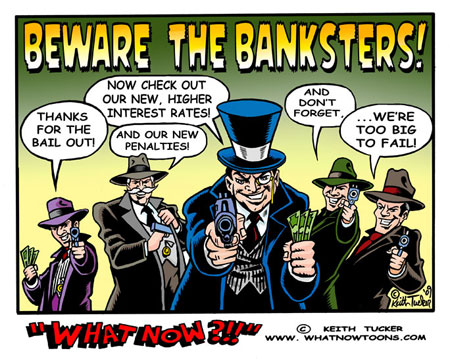
Amir Bihde, a professor at Tuft's Fletcher School of Law and Diplomacy, argues for "Boring Banks", HERE.
Mitt Romney's crazy talk
 |
| "The guy who fired you." |
Harold Myerson at the Washington Post has it:
“Over the past three years, Barack Obama has been replacing our merit-based society with an Entitlement Society,” Mitt Romney wrote in USA Today last month. The coming election, Romney told Wall Street Journal editors last month, will be “a very simple choice” between Obama’s “European social democratic” vision and “a merit-based opportunity society — an American-style society — where people earn their rewards based on their education, their work, their willingness to take risks and their dreams.”
Romney’s assertions are the centerpiece of his, and his party’s, critique not just of Obama but of American liberalism generally. But they fail to explain how and why the American economy has declined the past few decades — in good part because they betray no awareness that Europe’s social democracies now fit the description of “merit-based opportunity societies” much more than ours does.
Monday, January 2, 2012
Ronald Reagan would be a pariah in the current version of the GOP
Eric Cantor was on 60 Minutes last night and it didn't go well, when he was challenged by interviewer Leslie Stahl on his notion of "compromise." Steve Benen at Political Animal has it:
Stahl: But you know, your idol, as I’ve read anyway, was Ronald Reagan. And he compromised.
Oldies But Goodies: Da Doo Ron Ron

Cantor: He never compromised his principles.
Stahl: Well, he raised taxes and it was one of his principles not to raise taxes.
Cantor: Well, he — he also cut taxes.
Stahl: But he did compromise —
Cantor: Well I —At that point, Cantor’s press secretary, off camera, interrupted the interview, yelling that Stahl was lying when she said Reagan raised taxes. As Stahl told “60 Minutes” viewers, “There seemed to be some difficulty accepting the fact that even though Ronald Reagan cut taxes, he also pushed through several tax increases, including one in 1982 during a recession.”
"Nobody Understands Debt"
Well, not "nobody." But most of the people talking the loudest about government debt and deficits don't have a clue - they are steeped in ill-informed ideology that doesn't match empirical evidence. (Or perhaps they are invested in the public not having a clue because of a self-interested anti-government agenda.)
Paul Krugman offers a New York Times column that is a useful primer on the real and imaginary issues related to federal budget deficits:
Paul Krugman offers a New York Times column that is a useful primer on the real and imaginary issues related to federal budget deficits:
In 2011, as in 2010, America was in a technical recovery but continued to suffer from disastrously high unemployment. And through most of 2011, as in 2010, almost all the conversation in Washington was about something else: the allegedly urgent issue of reducing the budget deficit.
This misplaced focus said a lot about our political culture, in particular about how disconnected Congress is from the suffering of ordinary Americans. But it also revealed something else: when people in D.C. talk about deficits and debt, by and large they have no idea what they’re talking about — and the people who talk the most understand the least.
Perhaps most obviously, the economic “experts” on whom much of Congress relies have been repeatedly, utterly wrong about the short-run effects of budget deficits. People who get their economic analysis from the likes of the Heritage Foundation have been waiting ever since President Obama took office for budget deficits to send interest rates soaring. Any day now!
And while they’ve been waiting, those rates have dropped to historical lows. You might think that this would make politicians question their choice of experts — that is, you might think that if you didn’t know anything about our postmodern, fact-free politics.


Saturday, December 31, 2011
Medicare is the most cost-effective health insurance program available in the US, period. No - make that an exclamation mark!
Economist Laura D'Andrea Tyson, debunking the unholy alliance of Blue Dog Democratic Senator Ron Wyden and Randian Nihilist Congressman Paul Ryan in their nonsensical proposal to overturn the Medicare system as somehow "saving money" by shifting beneficaries into private markets, explains the cost-effectiveness of Medicare compared to the "competitive" markets of private insurance:
Despite competition and choice in the private insurance system, Medicare spending has grown more slowly than private insurance premiums for comparable coverage for more than 30 years.
From 1970 to 2009, Medicare spending per beneficiary grew by an average of 1 percentage point less each year than comparable private insurance premiums. Between 2000 and 2009, Medicare’s cost advantage was even larger – its spending per beneficiary grew at an average annual rate of 5.1 percent while per-capita premiums for private health insurance plans grew at 7.2 percent, according to the Center on Budget and Policy Priorities.

In inflation-adjusted terms, Medicare spending per beneficiary increased more than 400 percent between 1969 and 2009 while private insurance premiums increased by more than 700 percent.
What explains Medicare’s sustained cost advantage over private insurance? Medicare has much lower administrative costs than private insurance (administrative costs account for about 14 percent of health care spending, or a whopping $360 billion a year).
And Medicare has considerable negotiating leverage with providers as a result of its huge enrollment. Private insurance plans are unable to negotiate payment rates with providers that are as low as Medicare’s rates, even though Medicare’s negotiating authority is tightly limited and often undermined by Congress.As anyone with a grain of common sense or empirical data understands, the problems within the Medicare system are not related to Medicare's model of social insurance but in the overall inflationary spirals of our unrestrained, for-profit health care system. Compared to other advanced economies with high-quality health care - and universal coverage - the US medical industry is exorbitantly expensive, but with outcomes that are, overall, worse in terms of life expectancy, infant mortality and other key indicators.
Friday, December 30, 2011
"Best Chart of 2011" - Whose Deficits?
Ezra Klein declared this graph, which originated with the New York Times - showing the relative contributions of Presidents BushJr and Obama to the national debt - the best of 2011. I think he's right, given the nonsense, deliberate disinformation and outright hysteria that's being promoted by the GOP about deficits and the "Euro-socialist" Obama:


Klein: "What’s also important, but not evident, on this chart is that Obama’s major expenses were temporary — the stimulus is over now — while Bush’s were, effectively, recurring. The Bush tax cuts didn’t just lower revenue for 10 years. It’s clear now that they lowered it indefinitely, which means this chart is understating their true cost. Similarly, the Medicare drug benefit is costing money on perpetuity, not just for two or three years. And Boehner, Ryan and others voted for these laws and, in some cases, helped to craft and pass them."
Thursday, December 29, 2011

Wednesday, December 28, 2011
The new nihilism
Peter Laarman at Religion Dispatches:
It still strikes me as odd that no one has taken to calling either Wall Street ethics or far-Right economic beliefs by their right name, which is nihilism. There’s been some prattle in the press about Ayn Rand’s influence, but religiously the problem is so much bigger and deeper than the renewed attention paid to this minor figure. What gives the New Nihilism a certain degree of invisibility is that some of the fiercest functional nihilists claim to be staunch supporters of traditional beliefs and traditional hierarchies. Paul Ryan and Eric Cantor are no more likely to say they don’t really believe in anything than are Brian Moynihan and Lloyd Blankfein. These dudes believe in markets, of course, but they don’t choose to see that the way in which financial markets actually function today — with huge mechanical trades done at lightning speed and at great profit but without any regard to recognizable human values — perfectly expresses a high-order moral nihilism, if not a metaphysical nihilism. I can’t bring back Nietzsche or Heidegger to validate me on this. You just have to take my word for it: nihilism.

Tuesday, December 27, 2011
"It's cheaper for the U.S. to finance its debt today than it was when we last had surpluses"

That this agenda was rooted as much in the GOP's desire to worsen the economy as their back door to the White House and control of Congress more than any faith in "markets" seems likely given what the actual markets for US debt were telling us as the debate unfolded. Ezra Klein at Wonkbook:
In Washington, 2011 was all about dangers posed by America’s deficits. Republicans said deficit reduction was priority number one. Democrats mostly went along. But in the markets, the story was precisely the opposite. As Daniel Kruger reports in Bloomberg, demand for American debt was stronger in 2011 than in any year since 1995. It's cheaper for the U.S. to finance its debt today than it was when we last had surpluses...
Monday, December 26, 2011
Why I'm supporting the conservative in 2012
E.J. Dionne explains that, in the current political climate, our moderately liberal President Obama is also the only authentically conservative candidate - bent on strengthening our existing modest social compact and preserving the post-New Deal balance of public interest vs. concentrated economic power (and although Dionne doesn't note it, guaranteeing civil rights for all Americans) against the radical reactionary designs of the GOP to dismantle the system, slash government and spread poisonous paranoia:
At a moment when the nation wonders whether politicians can agree on anything, here is something that unites the Republican presidential candidates — and all of them with President Obama: Everyone agrees that the 2012 election will be a turning point involving one of the most momentous choices in U.S. history.
True, candidates (and columnists) regularly cast an impending election as the most important ever. Campaigning last week in Pella, Iowa, Republican Rick Santorum acknowledged as much. But he insisted that this time, the choice really was that fundamental. “The debate,” he said, “is about who we are.”
Speaking not far away, in Mount Pleasant, Newt Gingrich went even further, and was more specific. “This is the most important election since 1860,” he said, “because there’s such a dramatic difference between the best food-stamp president in history and the best paycheck candidate.” Thus did Gingrich combine historic sweep with a cheap and inaccurate attack. Nonetheless, it says a great deal that Gingrich chose to reach all the way back to the election that helped spark the Civil War.
Mitt Romney was on the same page in a speech in Bedford, N.H. “This is an election not to replace a president but to save a vision of America,” he declared. “It’s a choice between two destinies.” Sounding just like Santorum, he urged voters to ask: “Who are we as Americans, and what kind of America do we want for our children?”
At long last, have they no sense of decency?
Obama could not agree more. “This is not just another political debate,” the president said in his theme-setting speech in Osawatomie, Kan., earlier this month. “This is a make-or-break moment for the middle class, and for all those who are fighting to get into the middle class.”
On this one, Santorum, Gingrich, Romney and Obama all have it right. For the first time since Barry Goldwater made the effort in 1964, the Republican Party is taking a run at overturning the consensus that has governed U.S. political life since the Progressive era.


The Radical Anti-Environmental Republican Agenda
Paul Krugman on "Springtime for Toxics":
Here’s what I wanted for Christmas: something that would make us both healthier and richer. And since I was just making a wish, why not ask that Americans get smarter, too?
Surprise: I got my wish, in the form of new Environmental Protection Agency standards on mercury and air toxics for power plants. These rules are long overdue: we were supposed to start regulating mercury more than 20 years ago. But the rules are finally here, and will deliver huge benefits at only modest cost.
So, naturally, Republicans are furious. But before I get to the politics, let’s talk about what a good thing the E.P.A. just did.
As far as I can tell, even opponents of environmental regulation admit that mercury is nasty stuff. It’s a potent neurotoxicant…

Saturday, December 24, 2011
"The Big Lie"
More debunking of the fraudulent "Fannie and Freddie caused the mortgage meltdown" line coming out of Amerian Enterprise Institute and other desperate right-wing noisemakers, by Joe Nocera HERE.
Thursday, December 22, 2011
The 10 worst economic ideas of 2011
Jeff Madrick at Roosevelt Institute:
Let’s hope the New Year brings some new ideas, because this year’s couldn’t have been much worse — or more widespread.
I was at an Occupy Wall Street demonstration this weekend and many clergy addressed the group. One nun told the crowd it was Christmas season and that it was time for something new to be born in America.
It was a nice thought, and I hope that the “something new” is good sense, because it has been a year in which some of the worst economic ideas ever have gained support and are being applied around the world. So here’s my list of the 10 worst economic ideas of 2011:
Top ten from the dumb and dumber...
1. Taxes should be more regressive.
At the top of the list for sheer scandalous insensitivity are Herman Cain’s and New Gingrich’s tax plans for America. Cain and Gingrich are both flat tax advocates. Cain proposes “9-9-9″ — a 9 percent sales tax, 9 percent income tax, and 9 percent corporate tax. He would also eliminate most deductions. Would this raise more or less money? The romantic conservatives claim the lower income tax rate would mean more growth. Never mind that the evidence to support that claim has been found profoundly lacking time and again.

The Payroll Tax Cut Extension - GOP holds recovery hostage
 |
| Be careful where you point your gun... |
Congress has not been able to agree on extending the payroll tax cut, and as it stands, payroll taxes will increase in January. What impact will this gridlock have on the economy? What about the expiration of unemployment benefits, another effect of the failure to produce legislation on the payroll tax cut?
The payroll tax cut amounts to around $1,000 per year for the typical household, which adds up to a around $120 billion per year in additional purchasing power for the total workforce. If the payroll tax cut is not extended when Congress reconvenes, losing that much purchasing power would make an already slow recovery even slower...
Wednesday, December 21, 2011
"No, Conservatives, the Bush Recession Did Not Alleviate Economic Inequality"
Winning Progressive takes on some recent right-wing push-back and misdirection as the issue of income inequality gains resonance with the American public:
Showing how out of touch they are with everyday Americans, conservatives have latched
onto the news that the share of national income taken in by the top 1% fell from 23% in 2007 to “only” 17% in 2009 to contend that the focus of Occupy Wall Street and others on economic inequality is somehow misguided. For example, in a post titled “The 1% Ain’t What It Used To Be,” conservative blogger Megan McCardle responded that “we don’t want to spend years focused on income inequality, only to learn that the financial crisis fixed it for us.” Conservative economics professor Steven Kaplan of the University of Chicago business school echoed such doubts and actually offered a defense of inequality, stating in the New York Times that:
“It’s very interesting that [inequality] has become such a big topic now when the numbers are back to where they were in the 1990s,” said Steven Kaplan, an economist at the University of Chicago’s business school. “People didn’t seem to be complaining about it then.”
Pointing to the recent declines at the top, Mr. Kaplan argues the Occupy protesters have accused the wrong villain by focusing on inequality, which he called an inevitable byproduct of growth. “If you want to reduce inequality, all you need to do is put the economy in a recession,” he said. “If you want the economy to do well, as all of us do, then you’ll get more inequality.”Kaplan’s effort to link growth and economic inequality as inherently related is historically incorrect. For example, from 1950 to 1980, the share of income taken by the top 1% remained below 12% in all but one year, and was below 10% in 13 of those years. During that same time period, the US economy experience virtually uninterrupted growth. When the economy dipped in the early 1980s, the share of income taken by the top 1% increased. While it is true that most recessions lead to a decline in the share of income for the top 1%, the historical record does not support the contention that economic inequality is the inevitable byproduct of growth. In addition, while some level of inequality may be necessary for economic growth, elevated levels of inequality – such as those in the US today - actually stunt economic growth.
Monday, December 19, 2011
"Tax inequality"

An interesting, innovative idea for tax policy to stem the rising tide of income inequality, from law professors Aaron Edlin and Ian Ayres, HERE.
Sunday, December 18, 2011
Krugman on GOP Monetary Madness
Ron Paul's crank Gold Buggery is the new GOP "mainstream." Paul Krugman describes the descent into madness:
Mr. Paul identifies himself as a believer in “Austrian” economics — a doctrine that it goes without saying rejects John Maynard Keynes but is almost equally vehement in rejecting the ideas of Milton Friedman. For Austrians see “fiat money,” money that is just printed without being backed by gold, as the root of all economic evil, which means that they fiercely oppose the kind of monetary expansion Friedman claimed could have prevented the Great Depression — and which was actually carried out by Ben Bernanke this time around.
O.K., a brief digression: the Federal Reserve doesn’t actually print money (the Treasury does that). But the Fed does control the “monetary base,” the sum of bank reserves and currency in circulation. So when people talk about Mr. Bernanke printing money, what they really mean is that the Fed expanded the monetary base.
And there has, indeed, been a huge expansion of the monetary base. After Lehman Brothers fell, the Fed began lending large sums to banks as well as buying a wide range of other assets, in a (successful) attempt to stabilize financial markets, in the process adding large amounts to bank reserves. In the fall of 2010, the Fed began another round of purchases, in a less successful attempt to boost economic growth. The combined effect of these actions was that the monetary base more than tripled in size.

Austrians, and for that matter many right-leaning economists, were sure about what would happen as a result: There would be devastating inflation. One popular Austrian commentator who has advised Mr. Paul, Peter Schiff, even warned (on Glenn Beck’s TV show) of the possibility of Zimbabwe-style hyperinflation in the near future.
So here we are, three years later. How’s it going? Inflation has fluctuated, but, at the end of the day, consumer prices have risen just 4.5 percent, meaning an average annual inflation rate of only 1.5 percent. Who could have predicted that printing so much money would cause so little inflation? Well, I could. And did. And so did others who understood the Keynesian economics Mr. Paul reviles. But Mr. Paul’s supporters continue to claim, somehow, that he has been right about everything.
Thursday, December 15, 2011
The GOP candidates' plan to wreck the economy
Tim Dickinson at Rolling Stone on the GOP "Crazy":
 |
| The Little Rascals |
While threatening to slash the safety net for millions of Americans, the GOP candidates are also committed to a brutal austerity program that would tip the nation back into recession – if not a full-scale depression. The proposal in question is a constitutional amendment that would require the federal government to pass a balanced budget each year.Read Dickinson's complete "The GOP's Crackpot Agenda" HERE.
According to Macroeconomic Advisers, a top economic forecaster, balancing the budget in 2012 alone would throw 15 million Americans out of work, double unemployment to 18 percent and contract the U.S. economy by 17 percent. Going forward, the government would be barred from borrowing money during hard times to provide unemployment benefits, food stamps and other essential aid to those in need. As a result, the analysts report, "recessions would be deeper and longer." Even in times of plenty, a balanced-budget amendment would "retard economic growth" by increasing economic uncertainty – which Republicans have repeatedly blamed as the root of the current lackluster recovery.
Wednesday, December 14, 2011
The roots and the depth of the Great Recession
World-class economist Joseph Stiglitz has an essential essay in Vanity Fair, in which he uses new research and insights into the causes of the Great Depression to suggest that we need a fundamental rethinking of how to tackle the current crisis:
Stiglitz' analysis and conclusions are too important to simply excerpt or summarize. Read his entire piece HERE.The trauma we’re experiencing right now resembles the trauma we experienced 80 years ago, during the Great Depression, and it has been brought on by an analogous set of circumstances. Then, as now, we faced a breakdown of the banking system. But then, as now, the breakdown of the banking system was in part a consequence of deeper problems. Even if we correctly respond to the trauma—the failures of the financial sector—it will take a decade or more to achieve full recovery. Under the best of conditions, we will endure a Long Slump. If we respond incorrectly, as we have been, the Long Slump will last even longer, and the parallel with the Depression will take on a tragic new dimension.
Until now, the Depression was the last time in American history that unemployment exceeded 8 percent four years after the onset of recession. And never in the last 60 years has economic output been barely greater, four years after a recession, than it was before the recession started. The percentage of the civilian population at work has fallen by twice as much as in any post-World War II downturn. Not surprisingly, economists have begun to reflect on the similarities and differences between our Long Slump and the Great Depression. Extracting the right lessons is not easy.

Tuesday, December 13, 2011
The awfulness cont. - Newt's tax plan
Unfortunately we have to review the noxious stuff that spews forth from Newt Gingrich. Robert Reich has the latest here:
Newt Gingrich has done it again. With his new tax plan he has raised the bar from irresponsibility to recklessness.
Every dollar estimate I’m about to share with you comes from the independent, non-partisan Tax Policy Center – a group whose estimates are used by almost everyone in Washington regardless of political persuasion.
First off, Newt’s plan increases the federal budget deficit by about $850 billion – in a single year!

"Do as I say, not as I do..."
James Suroweicki on the default double-standard for mortgage-holders and corporations:
We normally say that a company “went bankrupt,” implying that it had no choice. But when, recently, American Airlines filed for bankruptcy, it did so deliberately. The airline had four billion dollars in the bank and could have kept paying its bills. But it has been losing money for a while, and its board decided that it was foolish to keep throwing good money after bad. Declaring bankruptcy will trim American’s debt load and allow it to break its union contracts, so that it can slim down and cut costs.
American wasn’t stigmatized for the move. Instead, analysts hailed it as “very smart.” It is now generally accepted that when it’s economically irrational for a company to keep paying its debts it will try to renegotiate them or, failing that, default. For creditors, that’s just the price of business. But when it comes to another set of borrowers the norms are very different. The bursting of the housing bubble has left millions of homeowners across the country owing more than their homes are worth. In some areas, well over half of mortgages are underwater, many so deeply that people owe forty or fifty per cent more than the value of their homes. In other words, a good percentage of Americans are in much the same position as American Airlines: they can still pay their debts, but doing so is like setting a pile of money on fire every month.
These people have no hope of ever making a return on their investment in their homes. So for many of them the rational solution would be a “strategic default”—walking away from the mortgage and letting the bank take the house. Yet the vast majority of underwater borrowers keep faithfully paying their mortgages; studies suggest that perhaps only a quarter of all foreclosures are strategic. Given how much housing prices have fallen, the question is why more people aren’t just walking away.

Sunday, December 11, 2011
Tales of Income Inequality
 Think Progress:
Income inequality in the U.S. is currently the highest its been since the 1920s, with the 400 richest Americans (who are all billionaires) having as much wealth as the bottom 50 percent of Americans combined. And as it turns out, just one wealthy family has managed to amass a fortune equal to that of the combined net worth of the bottom 30 percent of Americans — the Waltons, heirs to the Walmart fortune...
Saturday, December 10, 2011
The Foreclosure Crisis
Chris Hayes on the foreclosure "tsunami" and appropriate response:
Visit msnbc.com for breaking news, world news, and news about the economy
Friday, December 9, 2011
More true facts - the empirical evidence suggests that cutting top marginal tax rates on the rich increases non-productive income inequality rather than economic growth
Dan Buecke at Bloomberg:
This should get Grover Norquist up off the couch: a paper by a prominent team of economists says the tax rate for top U.S. earners could be hiked to 83 percent without hurting anyone but the “mega rich.” And in what’s sure to add gasoline to the income-inequality debate, they suggest pay increases for the wealthiest few reflect mostly “rent seeking” — econo-speak for unshackled greed — rather than executive-suite productivity improvements.
Thomas Piketty of the Paris School of Economics, Emmanuel Saez of Berkeley and Stefanie Stantcheva of MIT reach those conclusions after disputing that tax cuts in several countries since the 1970s had any real impact on per-capita GDP growth. As they say in their less wonky summary (hat tip to 3 Quarks Daily)... “countries that made large cuts in top tax rates such as the United Kingdom or the United States have not grown significantly faster than countries that did not, such as Germany or Denmark.”

What does show a strong correlation is falling tax rates and the share of pre-tax income held by the top 1 percent — doubled in the U.S., to more than 20 percent, over the past 40 years. (emphasis added)
True facts - "A larger welfare state can mean a lower deficit"
 |
| Robert Samuelson |
Speaking of things that the European crisis is not about (debt and deficits), while I was in Germany, my colleague Robert Samuelson wrote that “Europe’s turmoil is more than a currency crisis and was inevitable, in some form, even if the euro had never been created. It’s ultimately a crisis of the welfare state, which has grown too large to be easily supported economically.”
I don’t think that quite works. Take Germany. They have a pretty big welfare state: pensions, health care, paid vacations, unemployment benefits equal to two-thirds of one’s income. Indeed, the Organization for Economic Cooperation and Development keeps track of social spending — unemployment, old-age pensions, health care, etc — as a percentage of GDP. In 2007, Germany spent 25.2 percent of their GDP on such things. Greece spent 21.3 percent on social policies. Yet Greece is in crisis, and Germany is fine.
To bring this across the Atlantic, you could argue that the United States’s debt burden is the product of an insufficiently large welfare state — at least with regard to health care.
"The Wrong Fix" for the Eurozone
Harold Myerson at The American Prospect:
(T)he deal that German Chancellor Angela Merkel and French President Nicolas Sarkozy struck to save the Eurozone will inflict years of austerity on European nations that are already mired in depression. Spain, for instance, has an unemployment rate of about 20 percent and a youth unemployment rate that is approaching a mind-boggling 50 percent. It needs a massive Keynesian jolt to its economy, not budgetary constraints that will condemn it to a decade or quarter-century of penury...

(T)he Merkel-Sarokzy solution was based on a misdiagnosis of Europe’s woes. Some of Europe’s current basket cases were actually running budget surpluses in the years before the Lehman meltdown. Ireland and Spain weren’t overspending at all—but the banks and investors speculating on their housing markets most certainly were. When their banks went under, their economies collapsed, driving their unemployment rates, and their budget deficits, sky-high. If Ireland and Spain could do it over again, they’d have adopted far tighter bank regulations—something that the Merkel-Sarkozy deal doesn’t call for...
Thursday, December 8, 2011
Why we can't have nice things...

Between 2008 and 2010, 30 large corporations spent more on lobbying Washington than they spent on taxes. Details here, via ThinkProgress.
General Electric, of course, tops the list.
Tuesday, December 6, 2011
Obama in Osawatomie - the matter of Kansas and renewing populism
Today President Obama went on the offensive in Osawatomie, Kansas. His speech struck some welcome populist chords. Osawatomie is a historic town - best known to historians for the Battle of Osawatomie, which in 1856 was an early skirmish in what eventually became the Civil War. In the "Bloody Kansas" warfare over the eventual fate of the territory as a "free state", pro-slavery forces attacked the town - being defended by the radical abolitionist John Brown - and burned it to the ground.
In 1910 progressive Republican Theodore Roosevelt gave a notable speech in Osawatomie, focusing on the dangers of economic concentration and the corruption of politics by corporate money. TR's "money quote":

In 1910 progressive Republican Theodore Roosevelt gave a notable speech in Osawatomie, focusing on the dangers of economic concentration and the corruption of politics by corporate money. TR's "money quote":

At many stages in the advance of humanity, this conflict between the men who possess more than they have earned and the men who have earned more than they possess is the central condition of progress. In our day it appears as the struggle of freemen to gain and hold the right of self-government as against the special interests, who twist the methods of free government into machinery for defeating the popular will. At every stage, and under all circumstances, the essence of the struggle is to equalize opportunity, destroy privilege, and give to the life and citizenship of every individual the highest possible value both to himself and to the commonwealth.Here's President Obama's message from Osawatomie, which reclaimed some of Teddy Roosevelt's populist narrative:
(F)or most Americans, the basic bargain that made this country great has eroded. Long before the recession hit, hard work stopped paying off for too many people. Fewer and fewer of the folks who contributed to the success of our economy actually benefitted from that success. Those at the very top grew wealthier from their incomes and investments than ever before. But everyone else struggled with costs that were growing and paychecks that weren’t – and too many families found themselves racking up more and more debt just to keep up.

Monday, December 5, 2011
The "Job Creator"
The LA Times unpacks the "Mitt" Myth of Willard M. Romney as an entrepreneurial business man comitted to "job creation":


Shortly after Mitt Romney resigned from Bain Capital in 1999 to run the Olympics in Salt Lake City, potential investors received a prospectus touting the extraordinary profits earned by the private equity firm that Romney controlled for 15 years.
During that time, Boston-based Bain acquired more than 115 companies, according to the prospectus. Bain's estimated annual returns were more than five times that of the Dow Jones Industrial Average in the same period.
Now a front-runner for the Republican presidential nomination, Romney says his Bain experience shows he knows how to create jobs. He often cites Bain's investment in a little-known office supply store called Staples, which now employs more than 90,000 worldwide.
But a closer examination of the prospectus paints a different picture of Bain's operation. Under Romney's leadership, Bain became one of the nation's top leveraged-buyout firms, helping lead a trend in which companies were acquired using debt often pledged against their own assets or earnings.
Sunday, December 4, 2011
Newt Gingrich - a man utterly dishonest and corrupt, driven by ignorance, shamelessness and unfettered self-regard
New York Times columnist Charles Blow examines the latest iteration of Newt Gingrich's awfulness:
Newt Gingrich has reached a new low, and that is hard for him to do.
"I am now a famous person. I represent real power."
Nearly two weeks after claiming that child labor laws are “truly stupid” and implying that poor children should be put to work as janitors in their schools, he now claims that poor children don’t understand work unless they’re doing something illegal.
On Thursday, at a campaign stop in Iowa, the former House speaker said, “Start with the following two facts: Really poor children in really poor neighborhoods have no habits of working and have nobody around them who works. So they literally have no habit of showing up on Monday. They have no habit of staying all day. They have no habit of ‘I do this and you give me cash’ unless it’s illegal.” (His second “fact” was that every first generational person he knew started work early.)
This statement isn’t only cruel and, broadly speaking, incorrect, it’s mind-numbingly tone-deaf at a time when poverty is rising in this country. He comes across as a callous Dickensian character in his attitude toward America’s most vulnerable — our poor children. This is the kind of statement that shines light on the soul of a man and shows how dark it is.

Saturday, December 3, 2011
Unemployment statistics - how good is the news?
University of Oregon economist Mark Thoma digs beneath the surface numbers indicating a drop in "official" unemployment HERE.
Friday, December 2, 2011
The Euro: Can the center hold?

Economist Austin Goolsbee, who recently left the administration to return to teaching at Univ. of Chicago, doesn't believe the Eurozone can hold together...and he explains succinctly why it was a bad idea in the first place. Goolsbee's interview with Ezra Klein is worth a read in it's entirety - a concise picture of some of the central problems in this confusing and complex picture. HERE.
A voice from the "1%" explains a fundamental economic reality: The rich are not the "job creators."
Venture capitalist Nick Hanauer - who helped launch Amazon.com among other technology start-ups - ventures beneath the simplistic rhetoric and calculated misconceptions about job creation and rational tax policy in this op-ed from Bloomberg:
It is a tenet of American economic beliefs, and an article of faith for Republicans that is seldom contested by Democrats: If taxes are raised on the rich, job creation will stop.
Trouble is, sometimes the things that we know to be true are dead wrong. For the larger part of human history, for example, people were sure that the sun circles the Earth and that we are at the center of the universe. It doesn’t, and we aren’t. The conventional wisdom that the rich and businesses are our nation’s “job creators” is every bit as false.
I’m a very rich person. As an entrepreneur and venture capitalist, I’ve started or helped get off the ground dozens of companies in industries including manufacturing, retail, medical services, the Internet and software. I founded the Internet media company aQuantive Inc., which was acquired by Microsoft Corp. (MSFT) in 2007 for $6.4 billion. I was also the first non-family investor in Amazon.com Inc. (AMZN)
Even so, I’ve never been a “job creator.” I can start a business based on a great idea, and initially hire dozens or hundreds of people. But if no one can afford to buy what I have to sell, my business will soon fail and all those jobs will evaporate.

Thursday, December 1, 2011
"A Banker Speaks, With Regret"
Great Nick Kristoff column HERE in which a former CHASE mortgage manager reflects on the practices that brought the global economy near collapse. A couple of money quotes:
(W)hen mortgages were securitized and sold off to investors, he said, senior bankers turned a blind eye to shortcuts.
“The bigwigs of the corporations knew this, but they figured we’re going to make billions out of it, so who cares? The government is going to bail us out. And the problem loans will be out of here...”
"Some account executives earned a commission seven times higher from subprime loans, rather than prime mortgages. So they looked for less savvy borrowers — those with less education, without previous mortgage experience, or without fluent English — and nudged them toward subprime loans.Read Kristoff's entire NYTs column. It's a rare admission from an industry insider on the shame - or perhaps better put, shamelessness - of the financial sector that still controls the central levers of our economy and is currently making unprecedented profits while the country continues to suffer from what they have wrought.
These less savvy borrowers were disproportionately blacks and Latinos...and they ended up paying a higher rate so that they were more likely to lose their homes. Senior executives seemed aware of this racial mismatch... and frantically tried to cover it up...
(W)hat is scandalous is the basic unfairness of what has transpired. The federal government rescued highly paid bankers from their reckless decisions. It protected bank shareholders and creditors. But it mostly turned a cold shoulder to some of the most vulnerable and least sophisticated people in America. Last year alone, banks seized more than one million homes...
My daughter and I are reading Steinbeck’s “Grapes of Wrath” aloud to each other, and those Depression-era injustices seem so familiar today. That’s why the Occupy movement resonates so deeply: When the federal government goes all-out to rescue errant bankers, and stiffs homeowners, that’s not just bad economics. It’s also wrong.
Wednesday, November 30, 2011
"Newt Gingrich and the destruction of Congressional expertise"
Bruce Bartlett takes on some Gingrichian nonsense - rooted, as are most of Newt's manifest sins, in his egomaniacal grandiosity - HERE.
Tuesday, November 29, 2011
The failure of mainstream economics
University of Massachusetts economics professor Nancy Folbre at Economix discusses the limitations of her profession:
The Occupy Wall Street movement, displaced from some key geographic locations, now enjoys a small but significant encampment among economists.
Concerns about the impact of growing economic inequality fit neatly into a larger critique of mainstream economic theory and its deep faith in the efficiency of markets.
Many unbelievers (including me) insist that we inhabit a global capitalist system rather than an efficient market. Willingness to use the C-word (capitalism) often signals concerns about a concentration of economic power that unfairly limits individual choices, undermines political democracy, generates financial and ecological crises and limits access to alternative economic ideas.
We can’t address these concerns effectively without a wider discussion of them.
Seventy Harvard students dramatized dissatisfaction with the economics profession when they walked out of Prof. Gregory Mankiw’s introductory economics class on Nov. 2, protesting, in an open letter to their instructor, that the course “espouses a specific — and limited — view of economics that we believe perpetuates problematic and inefficient systems of economic inequality in our society today.” (Professor Mankiw, a periodic contributor to the Economic View column in the Sunday Business section of The New York Times, discussed the protest in an interview with National Public Radio.)
The event prompted online discussion of conservative bias in introductory economics textbooks, including an anti-Mankiw blog set up by Daniel MacDonald, a graduate student in my own department. Prof. John Davis of the University of Amsterdam and Marquette University posted a video arguing that economic researchers, like fish, engage in herd behavior in order to minimize individual risk...

Monday, November 28, 2011
Obama as "big spender" is right-wing fantasy

Indeed, federal spending rose from 19.6% of GDP in 2007 to 23.8% in 2010 (it was briefly 25 in 2009, but that was a number distorted by the financial bailouts). So there has been a roughly 4 points of GDP rise in the spending share. What’s that about?
Well, part of the answer is that the ratio is up because the denominator is down. According to CBO estimates, in fiscal 2010 the economy operated about 7 percent below potential. This means that even if what the government was doing hadn’t changed, the federal spending share of GDP would have risen by 1.4 percentage points.
Then, look inside the budget data (pdf), specifically at Table E-10. You’ll see a surge in spending on “income security”; that’s basically unemployment insurance, food stamps, and similar items. In other words, spending on safety-net programs is up because the economy is depressed, and more people are falling into the safety net.
Subscribe to:
Posts (Atom)