Showing posts with label Income Inequality. Show all posts

Saturday, June 28, 2014

"Inequality Is Not Inevitable"


Joseph Stiglitz @ NYT:

AN insidious trend has developed over this past third of a century. A country that experienced shared growth after World War II began to tear apart, so much so that when the Great Recession hit in late 2007, one could no longer ignore the fissures that had come to define the American economic landscape. How did this “shining city on a hill” become the advanced country with the greatest level of inequality?

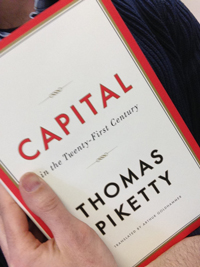
One stream of the extraordinary discussion set in motion by Thomas Piketty’s timely, important book, “Capital in the Twenty-First Century,” has settled on the idea that violent extremes of wealth and income are inherent to capitalism. In this scheme, we should view the decades after World War II — a period of rapidly falling inequality — as an aberration.

This is actually a superficial reading of Mr. Piketty’s work, which provides an institutional context for understanding the deepening of inequality over time. Unfortunately, that part of his analysis received somewhat less attention than the more fatalistic-seeming aspects.


Over the past year and a half, The Great Divide, a series in The New York Times for which I have
served as moderator, has also presented a wide range of examples that undermine the notion that thereare any truly fundamental laws of capitalism. The dynamics of the imperial capitalism of the 19th century needn’t apply in the democracies of the 21st. We don’t need to have this much inequality in America.

Our current brand of capitalism is an ersatz capitalism. For proof of this go back to our response to the Great Recession, where we socialized losses, even as we privatized gains. Perfect competition should drive profits to zero, at least theoretically, but we have monopolies and oligopolies making persistently high profits. C.E.O.s enjoy incomes that are on average 295 times that of the typical worker, a much higher ratio than in the past, without any evidence of a proportionate increase in productivity.

If it is not the inexorable laws of economics that have led to America’s great divide, what is it? The straightforward answer: our policies and our politics. People get tired of hearing about Scandinavian success stories, but the fact of the matter is that Sweden, Finland and Norway have all succeeded in having about as much or faster growth in per capita incomes than the United States and with far greater equality.

Source: The Atlantic
So why has America chosen these inequality-enhancing policies? Part of the answer is that as World War II faded into memory, so too did the solidarity it had engendered. As America triumphed in the Cold War, there didn’t seem to be a viable competitor to our economic model. Without this international competition, we no longer had to show that our system could deliver for most of our citizens.

Ideology and interests combined nefariously. Some drew the wrong lesson from the collapse of the Soviet system. The pendulum swung from much too much government there to much too little here. Corporate interests argued for getting rid of regulations, even when those regulations had done so much to protect and improve our environment, our safety, our health and the economy itself.

But this ideology was hypocritical. The bankers, among the strongest advocates of laissez-faire economics, were only too willing to accept hundreds of billions of dollars from the government in the bailouts that have been a recurring feature of the global economy since the beginning of the Thatcher-Reagan era of “free” markets and deregulation.

The American political system is overrun by money. Economic inequality translates into political inequality, and political inequality yields increasing economic inequality. In fact, as he recognizes, Mr. Piketty’s argument rests on the ability of wealth-holders to keep their after-tax rate of return high relative to economic growth. How do they do this? By designing the rules of the game to ensure this outcome; that is, through politics.

Wednesday, April 30, 2014

The knives come out for Piketty...and they are pretty dull

Kathleen Geier outlines "What Piketty’s Conservative Critics Get Wrong" @ The Baffler:
With his book Capital in the Twenty-First Century, Thomas Piketty has lobbed a truth bomb that has blown up several decades’ worth of received opinion about the way the economy works in capitalist societies. He makes a powerful, meticulously-argued, data-driven case that inequality is a feature of capitalist economies, not a bug. Let to its own devices, wealth tends to become highly concentrated. The only events likely to prevent our society from plunging into a dystopian spiral of inequity are, on the one hand, certain rarely occurring catastrophes, such as war or depression; or, on the other, dramatic government intervention in the economy, in the form of steep taxes on the wealthy.

You can see why conservatives are going to be enraged by this book.

A conservative backlash to Piketty was inevitable; the only surprise is that it’s taken so long to develop. But in the last week or so, responses from the right have finally begun to roll in. Send in the clowns!

Tuesday, April 29, 2014

Recovery Has Created Far More Low-Wage Jobs Than Better-Paid Ones

Annie Lowrey @ NYT:
WASHINGTON — The deep recession wiped out primarily high-wage and middle-wage jobs. Yet the strongest employment growth during the sluggish recovery has been in low-wage work, at places like strip malls and fast-food restaurants.
In essence, the poor economy has replaced good jobs with bad ones. That is the
conclusion of a new report from the National Employment Law Project, a research and advocacy group, analyzing employment trends four years into the recovery.

“Fast food is driving the bulk of the job growth at the low end — the job gains there are absolutely phenomenal,” said Michael Evangelist, the report’s author. “If this is the reality — if these jobs are here to stay and are going to be making up a considerable part of the economy — the question is, how do we make them better?”

The report shows that total employment has finally surpassed its pre-recession level. “The good news is we’re back to zero,” Mr. Evangelist said.

But job losses and gains have been skewed. Higher-wage industries — like accounting and legal work — shed 3.6 million positions during the recession and have added only 2.6 million positions during the recovery. But lower-wage industries lost two million jobs, then added 3.8 million.

Most of the jobs added during the recovery have been in lower-wage industries...

Saturday, April 19, 2014

The rich got richer

In what is beginning to sound like a "Dog Bites Man" story from the WSJ:
The rich got richer, the poor got poorer.

recent article by Labor Department senior economist Aaron Cobet highlights the sharp disparity between the wealthiest and poorest Americans in the aftermath of the 2007-2009 recession.

“While average income has returned to pre-recession levels, income gains have been distributed unevenly,” Mr. Cobet said.

The economist mined Labor Department data to show that the top 20% of earners accounted for more than 80% of the rise in household income from 2008-2012. Income fell for the bottom 20%.

More "Capital in the 21st Century"

Martin Wolff reviews Thomas PIketty's opus @ The Financial Times. Read at link or below:
French economist Thomas Piketty has written an extraordinarily important book. Open-minded readers will surely find themselves unable to ignore the evidence and arguments he has brought to bear.

Thursday, March 27, 2014

"Capital in the Twenty-first Century"


John Cassidy @ The New Yorker reviews the definitive new book on income inequality:
In the stately world of academic presses, it isn’t often that advance orders and
publicity for a book prompt a publisher to push forward its publication date. But that’s what Belknap, an imprint of Harvard University Press, did for “Capital in the Twenty-first Century,” a sweeping account of rising inequality by the French economist Thomas Piketty. Reviewing the French edition of Piketty’s book, which came out last year, Branko Milanovic, a former senior economist at the World Bank, called it “one of the watershed books in economic thinking.” The Economist said that it could change the way we think about the past two centuries of economic history. Certainly, no economics book in recent years has received this sort of attention... 
Piketty, who teaches at the Paris School of Economics, has spent nearly two decades studying inequality… The main task he set himself was exploring the hills and valleys of income and wealth, a subject that economics had largely neglected. At first, Piketty concentrated on getting the facts down, rather than interpreting them. Using tax records and other data, he studied how income inequality in France had evolved during the twentieth century, and published his findings in a 2001 book. A 2003 paper that he wrote with Emmanuel Saez, a French-born economist at Berkeley, examined income inequality in the United States between 1913 and 1998. It detailed how the share of U.S. national income taken by households at the top of the income distribution had risen sharply during the early decades of the twentieth century, then fallen back during and after the Second World War, only to soar again in the nineteen-eighties and nineties.

Monday, March 24, 2014

The widening productivity and income gap


If you must know only one fact about the U.S. economy, it should be this chart:

ch1_20140317_1
The chart shows that productivity, or output per hour of work, has quadrupled since 1947 in the United States. This is a spectacular achievement by an advanced economy.

The gains in productivity were quite widely shared from 1947 to 1980. Real income for the median U.S. family doubled during this time just as output per hour of work performed doubled. The rising tide was lifting all boats.

(But there has been a) remarkable separation in productivity and median real income since 1980. While the United States is producing twice as much per hour of work today compared to 1980, a small part of the gain in real income has gone to the bottom half of the income distribution. The gap between productivity and median real income is at an historic all-time high today.

Friday, March 14, 2014

The racial elephant in the wealth inequality room

Ned Resnikoff @ MSNBC:

In 1967, with the Civil Rights movement still in full swing and Jim Crow still looming in the rearview mirror, median household income was 43% higher for white, non-Hispanic households than for black households. But things changed dramatically over the next half century, as legal segregation faded into history. By 2011, median white household income was 72% higher than median black household income, according to a Census report from that year [PDF].

To say that economic inequality is still a heavily racialized phenomenon, even a generation after the end of the Civil Rights era, would be an understatement. Yet both major parties continue to discuss inequality in largely color-blind terms, only hinting at the role played by race.
The trend is even more startling when one looks at median household wealth instead of yearly income. In 1984, the white-to-black wealth ratio was 12-to-1, according to Pew Research Center. By 1995, the chasm had narrowed until median white income had only a 5-to-1 advantage over black income. But over the next 14 years the wealth gap began to grow once again, until it had skyrocketed up to 19-to-1 in 2009. 
 
Yet even a recent 204-page analysis of the federal War on Poverty, spearheaded by Rep. Paul Ryan, R-Wis., gives only passing mentions to racial disparity. In the first section of the report, which purports to explain the causes of modern poverty, Ryan and his co-authors bring up race only twice: Once to identify “the breakdown of the familiy as a key cause of poverty within the black community,” citing Daniel Patrick Moynihan, and again to applaud the narrowing of the “achievement gap” between white and black schoolchildren. Weeks later, during a radio appearance, Ryan said poverty is in part to blame on the fact that “inner cities” have a culture of “men not working.”

President Obama went a step forward in December’s major address on inequality, when he noted that “the painful legacy of discrimination means that African Americans, Latinos, Native Americans are far more likely to suffer from a lack of opportunity—higher unemployment, higher poverty rates.” Yet that amounted to a footnote in a speech that also included the line, “The opportunity gap in America is now as much about class as it is about race.”

“I think it doesn’t make for good politics,” said Color of Change executive director Rashad Robinson of the racial wealth gap. “It’s messy and requires us to be deep and think about much bigger and more long-term solutions than Washington’s oftentimes willing to deal with.”

Yet in a serious discussion about American inequality, the subject of race is essentially unavoidable. That’s because most of the pipelines to a higher economic class—such as employment and homeownership—are “oftentimes not equally accessible to black folks,” said Robinson.

Disparities in homeownership are a major driver of the racial wealth gap, according to a recent study from Brandeis University. According to the authors of the report, “redlining [a form of discrimination in banking or insurance practices], discriminatory mortgage-lending practices, lack of access to credit, and lower incomes have blocked the homeownership path for African-Americans while creating and reinforcing communities segregated by race.”

Many of the black families that have successfully battled their way to homeownership over the past few decades saw their nest eggs get pulverized by the 2008 financial collapse. The Brandeis researchers found that “half the collective wealth of African-American families was stripped away during the Great Recession,” in large part due to the collapse of the housing market and the subsequent explosion in the nationwide foreclosure rate.
Similarly, employment discrimination has done its part to ensure that black unemployment remains twice as high as white unemployment—a ratio that has stayed largely consistent since the mid-1950s. National Bureau of Economy Research fellows have found that resumes are significantly less likely to get a positive response from potential employers if the applicants have names that are more common in the black community. And an arrest for even a non-violent drug offense can haunt a job applicant for the rest of his life; combined with the fact that black people are nearly four times more likely to be arrested for marijuana possession than whites, despite using the drug at roughly the same rate, criminal background checks have helped to fuel racial inequity in job hiring...

Saturday, March 8, 2014

The richest 20% own over 80% of all financial assets

House of Debt blog

This means that when increases in the stock market are reported, the financial gains are skewed largely to the (already) wealthiest 20%.

"America's Long and Productive History of Class Warfare"

Harvard Business Review executive editor & author of  "The Myth of the Rational Market," Justin Fox @ HBR:
Six days before the election, the Republican nominee for president attended a fund-raising dinner at a posh New York restaurant. Two-hundred of the country’s richest and most powerful men were on hand. The next day, they were confronted with this atop the front page of one of the city’s leading newspapers:


This particular scan is from the historical-cartoon site HarpWeek, but the drawing has long been in the public domain — it ran in the now-defunct New York World on Oct. 30, 1884. The candidate was James G. Blaine (the droopy-eyed fellow in the center of the picture who is about to dig in to some Lobby Pudding), and the man who subjected him to this harsh treatment was Joseph Pulitzer, who had bought the World the previous year and was rapidly building it into the most popular and powerful newspaper the nation had ever seen.

Friday, March 7, 2014

Increasing the minimum wage saves taxpayers food stamps expenditures

minwage_snap

Paul Krugman and Bill Maher on craziness & paranoia among the clueless 1%

The comedian's version:


The economist's version:
Suddenly, or so it seems, inequality has surged into public consciousness — and neither the one percent nor its reliable defenders seems to know how to cope.

Some of the reactions are crazy — it’s Kristallnacht, they’re coming to kill us — with the craziness quite widespread; notice how many billionaires, plus of course the Wall Street Journal, rallied around Tom Perkins. But even the saner-sounding voices evidently have a hard time wrapping their minds around the notion that anyone might find 21st-century finance capitalism a bit, well, unfair.

Monday, January 20, 2014

"IMF warns on threat of income inequality"

Financial Times:
The International Monetary Fund has highlighted the threat posed to the global economy by growing income inequality as the world’s business and political leaders prepare to head off to the World Economic Forum in Davos this week.

Friday, January 17, 2014

Uh, oh! "Brooks Worst Column Ever!"

Robert Kuttner, piling on @ American Prospect, lowers the bar in considering today's Brooks offering a milestone of sorts:
Well, this is getting to be a habit. Alert readers may recall that a few weeks ago, I wrote a piece about Tom Friedman’s worst column ever, plugging efforts by a billionaire hedge fund friend to persuade college students that their enemy was Social Security. 

Now, Friedman’s colleague David Brooks has written an even worse column. It’s really hard to determine Brooks’ worst column ever, since he seems to turn out one every week.
Brooks’ latest piece, in Friday’s Times, begins inauspiciously, “Suddenly, the whole world is talking about income inequality.” (Where has Brooks been, Jupiter?)
Paul Krugman, the "Liberal Conscience" animated by fairly conventional Keynsianism, further diminishes Our Mr. Brooks:

Why We Talk About the One Percent

Many people in Washington, even those willing to concede that inequality has been rising rapidly, are uncomfortable talking about the famous 1 percent — perhaps because it sounds too populist, too much like an invitation to crowds with pitchforks. For a long time respectable discussion focused on the top 20 percent; today I see my colleague David Brooks talking about the top 5 percent.
But framing the discussion in terms of some broader group is in this case deeply misleading. Here’s what the Piketty-Saez numbers tell us about the top 5 percent (incomes in 2012 dollars):
            Piketty and Saez 
If you look at the bottom 4 percent of the top 5, you see good but not spectacular income gains. These are the kinds of gains that you might be able to explain in terms of skills, assortative mating, and so on. But the top 1 percent is in a different universe altogether. And in fact the gains within the top 1 percent are concentrated in an even smaller group: this is a Pareto distribution thing, in which the higher the income the greater the percentage gains.
The point is that using wider definitions than the one percent is, in effect, diluting the wolves of Wall Street by lumping them in with the upper middle class. Not the same story at all.

Friday, December 27, 2013

"The Fear Economy"

Professor Krugman @ NYTs:
More than a million unemployed Americans are about to get the cruelest of Christmas “gifts.” They’re about to have their unemployment benefits cut off. You see, Republicans in Congress insist that if you haven’t found a job after months of searching, it must be because you aren’t trying hard enough. So you need an extra incentive in the form of sheer desperation.

Friday, December 6, 2013

The Minimum Wage Brouhaha According to Comedy Central

Jon Stewart supports fast-food workers' strikes, invokes the populist compassion of the new Pope and takes on the wretched, dim-witted, morally obtuse cretins of cable "business" chatter:


Wednesday, November 27, 2013

Pope Francis v. "Unfettered capitalism" and "The tyranny of markets"

The new Pope appears to be taking the church back to basics. Reuters via NYTs:
VATICAN CITY — Pope Francis attacked unfettered capitalism as "a new tyranny" and beseeched global leaders to fight poverty and growing inequality, in a document on Tuesday setting out a platform for his papacy and calling for a renewal of the Catholic Church.
The 84-page document, known as an apostolic exhortation, was the first major
work he has authored alone as pope and makes official many views he has aired in sermons and remarks since he became the first non-European pontiff in 1,300 years in March.

In it, Francis went further than previous comments criticizing the global economic system, attacking the "idolatry of money", and urged politicians to "attack the structural causes of inequality" and strive to provide work, healthcare and education to all citizens. 
He also called on rich people to share their wealth. "Just as the commandment
'Thou shalt not kill' sets a clear limit in order to safeguard the value of human life, today we also have to say 'thou shalt not' to an economy of exclusion and inequality. Such an economy kills," Francis wrote in the document issued on Tuesday. 
"How can it be that it is not a news item when an elderly homeless person dies of exposure, but it is news when the stock market loses 2 points?" 

The pope said renewal of the Church could not be put off and said the Vatican and its entrenched hierarchy "also need to hear the call to pastoral conversion". 

"I prefer a Church which is bruised, hurting and dirty because it has been out on the streets, rather than a Church which is unhealthy from being confined and from clinging to its own security," he wrote. 

Italian theologian Massimo Faggioli greeted the work as "the manifesto of Francis" while veteran Vatican analyst John Thavis called it a "Magna Carta for church reform". 

"The message on poverty sets Pope Francis on a collision course with neo-liberal Catholic thought, especially in the United States," said Faggioli, an expert on the Second Vatican Council and reform in the Catholic Church.

Tales of the Great Recession

Breadlines are making a comeback. At the NYT's Editorial Page Editor's blog, Teresa Tritch:
The Great Recession was the worst downturn since the Great Depression.  And yet, throughout the recent decline and today’s sluggish recovery, conditions have never seemed as bad as they were in the 1930s. Breadlines, for example, have not been commonplace.
That may be about to change.  

In an article published on Monday, The Times’s Patrick McGeehan described a line snaking down Fulton Street in Brooklyn last week, with people waiting to enter a food pantry run by the Bed-Stuy Campaign Against Hunger. The line was not an anomaly. Demand at all of New York City’s food pantries and soup kitchens has spiked since federal food stamps were cut on Nov. 1. The cut — which affects nearly all of the nation’s 48 million food stamp recipients — amounts to a loss of $29 a month for a New York City family of three. On the shoestring meal budgets of food stamp recipients, that’s enough for some 20 individual meals, according to the New York City Coalition Against Hunger.

The food stamp cuts are occurring even though need is still high and opportunity low. In a report released today, the Coalition estimates that one-sixth of the city’s residents and one-fifth of its children live in homes without enough to eat. Those numbers have not improved over the past three years. The lack of economic recovery for low income New Yorkers is at odds with gains at the top of the income ladder, reflected in soaring real estate prices, rising stock prices and big Wall Street bonuses.