At least five large studies in recent years have found the United States to be less mobile than comparable nations. A project led by Markus Jantti, an economist at a Swedish university, found that 42 percent of American men raised in the bottom fifth of incomes stay there as adults. That shows a level of persistent disadvantage much higher than in Denmark (25 percent) and Britain (30 percent) — a country famous for its class constraints.
Meanwhile, just 8 percent of American men at the bottom rose to the top fifth. That compares with 12 percent of the British and 14 percent of the Danes.
Despite frequent references to the United States as a classless society, about 62 percent of Americans (male and female) raised in the top fifth of incomes stay in the top two-fifths, according to research by the Economic Mobility Project of the Pew Charitable Trusts. Similarly, 65 percent born in the bottom fifth stay in the bottom two-fifths.
By emphasizing the influence of family background, the studies not only challenge American identity but speak to the debate about inequality. While liberals often complain that the United States has unusually large income gaps, many conservatives have argued that the system is fair because mobility is especially high, too: everyone can climb the ladder. Now the evidence suggests that America is not only less equal, but also less mobile.

The Titanic sails at dawn - politics, economics & culture
Thursday, January 5, 2012
More on social mobility in the United States as compared to Europe
Jason DeParle at the New York Times:


Wednesday, January 4, 2012
"Bring Back Boring Banks"
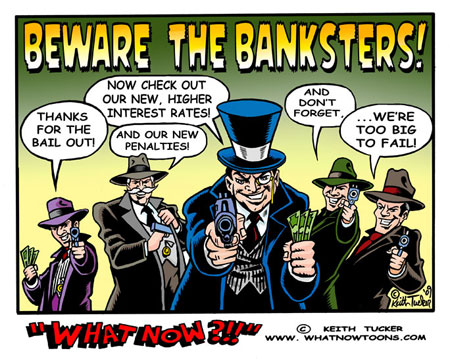
Amir Bihde, a professor at Tuft's Fletcher School of Law and Diplomacy, argues for "Boring Banks", HERE.
Mitt Romney's crazy talk
 |
| "The guy who fired you." |
Harold Myerson at the Washington Post has it:
“Over the past three years, Barack Obama has been replacing our merit-based society with an Entitlement Society,” Mitt Romney wrote in USA Today last month. The coming election, Romney told Wall Street Journal editors last month, will be “a very simple choice” between Obama’s “European social democratic” vision and “a merit-based opportunity society — an American-style society — where people earn their rewards based on their education, their work, their willingness to take risks and their dreams.”
Romney’s assertions are the centerpiece of his, and his party’s, critique not just of Obama but of American liberalism generally. But they fail to explain how and why the American economy has declined the past few decades — in good part because they betray no awareness that Europe’s social democracies now fit the description of “merit-based opportunity societies” much more than ours does.
Monday, January 2, 2012
Ronald Reagan would be a pariah in the current version of the GOP
Eric Cantor was on 60 Minutes last night and it didn't go well, when he was challenged by interviewer Leslie Stahl on his notion of "compromise." Steve Benen at Political Animal has it:
Stahl: But you know, your idol, as I’ve read anyway, was Ronald Reagan. And he compromised.
Oldies But Goodies: Da Doo Ron Ron

Cantor: He never compromised his principles.
Stahl: Well, he raised taxes and it was one of his principles not to raise taxes.
Cantor: Well, he — he also cut taxes.
Stahl: But he did compromise —
Cantor: Well I —At that point, Cantor’s press secretary, off camera, interrupted the interview, yelling that Stahl was lying when she said Reagan raised taxes. As Stahl told “60 Minutes” viewers, “There seemed to be some difficulty accepting the fact that even though Ronald Reagan cut taxes, he also pushed through several tax increases, including one in 1982 during a recession.”
"Nobody Understands Debt"
Well, not "nobody." But most of the people talking the loudest about government debt and deficits don't have a clue - they are steeped in ill-informed ideology that doesn't match empirical evidence. (Or perhaps they are invested in the public not having a clue because of a self-interested anti-government agenda.)
Paul Krugman offers a New York Times column that is a useful primer on the real and imaginary issues related to federal budget deficits:
Paul Krugman offers a New York Times column that is a useful primer on the real and imaginary issues related to federal budget deficits:
In 2011, as in 2010, America was in a technical recovery but continued to suffer from disastrously high unemployment. And through most of 2011, as in 2010, almost all the conversation in Washington was about something else: the allegedly urgent issue of reducing the budget deficit.
This misplaced focus said a lot about our political culture, in particular about how disconnected Congress is from the suffering of ordinary Americans. But it also revealed something else: when people in D.C. talk about deficits and debt, by and large they have no idea what they’re talking about — and the people who talk the most understand the least.
Perhaps most obviously, the economic “experts” on whom much of Congress relies have been repeatedly, utterly wrong about the short-run effects of budget deficits. People who get their economic analysis from the likes of the Heritage Foundation have been waiting ever since President Obama took office for budget deficits to send interest rates soaring. Any day now!
And while they’ve been waiting, those rates have dropped to historical lows. You might think that this would make politicians question their choice of experts — that is, you might think that if you didn’t know anything about our postmodern, fact-free politics.


Saturday, December 31, 2011
Medicare is the most cost-effective health insurance program available in the US, period. No - make that an exclamation mark!
Economist Laura D'Andrea Tyson, debunking the unholy alliance of Blue Dog Democratic Senator Ron Wyden and Randian Nihilist Congressman Paul Ryan in their nonsensical proposal to overturn the Medicare system as somehow "saving money" by shifting beneficaries into private markets, explains the cost-effectiveness of Medicare compared to the "competitive" markets of private insurance:
Despite competition and choice in the private insurance system, Medicare spending has grown more slowly than private insurance premiums for comparable coverage for more than 30 years.
From 1970 to 2009, Medicare spending per beneficiary grew by an average of 1 percentage point less each year than comparable private insurance premiums. Between 2000 and 2009, Medicare’s cost advantage was even larger – its spending per beneficiary grew at an average annual rate of 5.1 percent while per-capita premiums for private health insurance plans grew at 7.2 percent, according to the Center on Budget and Policy Priorities.

In inflation-adjusted terms, Medicare spending per beneficiary increased more than 400 percent between 1969 and 2009 while private insurance premiums increased by more than 700 percent.
What explains Medicare’s sustained cost advantage over private insurance? Medicare has much lower administrative costs than private insurance (administrative costs account for about 14 percent of health care spending, or a whopping $360 billion a year).
And Medicare has considerable negotiating leverage with providers as a result of its huge enrollment. Private insurance plans are unable to negotiate payment rates with providers that are as low as Medicare’s rates, even though Medicare’s negotiating authority is tightly limited and often undermined by Congress.As anyone with a grain of common sense or empirical data understands, the problems within the Medicare system are not related to Medicare's model of social insurance but in the overall inflationary spirals of our unrestrained, for-profit health care system. Compared to other advanced economies with high-quality health care - and universal coverage - the US medical industry is exorbitantly expensive, but with outcomes that are, overall, worse in terms of life expectancy, infant mortality and other key indicators.
Friday, December 30, 2011
"Best Chart of 2011" - Whose Deficits?
Ezra Klein declared this graph, which originated with the New York Times - showing the relative contributions of Presidents BushJr and Obama to the national debt - the best of 2011. I think he's right, given the nonsense, deliberate disinformation and outright hysteria that's being promoted by the GOP about deficits and the "Euro-socialist" Obama:


Klein: "What’s also important, but not evident, on this chart is that Obama’s major expenses were temporary — the stimulus is over now — while Bush’s were, effectively, recurring. The Bush tax cuts didn’t just lower revenue for 10 years. It’s clear now that they lowered it indefinitely, which means this chart is understating their true cost. Similarly, the Medicare drug benefit is costing money on perpetuity, not just for two or three years. And Boehner, Ryan and others voted for these laws and, in some cases, helped to craft and pass them."
Thursday, December 29, 2011

Wednesday, December 28, 2011
The new nihilism
Peter Laarman at Religion Dispatches:
It still strikes me as odd that no one has taken to calling either Wall Street ethics or far-Right economic beliefs by their right name, which is nihilism. There’s been some prattle in the press about Ayn Rand’s influence, but religiously the problem is so much bigger and deeper than the renewed attention paid to this minor figure. What gives the New Nihilism a certain degree of invisibility is that some of the fiercest functional nihilists claim to be staunch supporters of traditional beliefs and traditional hierarchies. Paul Ryan and Eric Cantor are no more likely to say they don’t really believe in anything than are Brian Moynihan and Lloyd Blankfein. These dudes believe in markets, of course, but they don’t choose to see that the way in which financial markets actually function today — with huge mechanical trades done at lightning speed and at great profit but without any regard to recognizable human values — perfectly expresses a high-order moral nihilism, if not a metaphysical nihilism. I can’t bring back Nietzsche or Heidegger to validate me on this. You just have to take my word for it: nihilism.

Tuesday, December 27, 2011
"It's cheaper for the U.S. to finance its debt today than it was when we last had surpluses"

That this agenda was rooted as much in the GOP's desire to worsen the economy as their back door to the White House and control of Congress more than any faith in "markets" seems likely given what the actual markets for US debt were telling us as the debate unfolded. Ezra Klein at Wonkbook:
In Washington, 2011 was all about dangers posed by America’s deficits. Republicans said deficit reduction was priority number one. Democrats mostly went along. But in the markets, the story was precisely the opposite. As Daniel Kruger reports in Bloomberg, demand for American debt was stronger in 2011 than in any year since 1995. It's cheaper for the U.S. to finance its debt today than it was when we last had surpluses...
Monday, December 26, 2011
Why I'm supporting the conservative in 2012
E.J. Dionne explains that, in the current political climate, our moderately liberal President Obama is also the only authentically conservative candidate - bent on strengthening our existing modest social compact and preserving the post-New Deal balance of public interest vs. concentrated economic power (and although Dionne doesn't note it, guaranteeing civil rights for all Americans) against the radical reactionary designs of the GOP to dismantle the system, slash government and spread poisonous paranoia:
At a moment when the nation wonders whether politicians can agree on anything, here is something that unites the Republican presidential candidates — and all of them with President Obama: Everyone agrees that the 2012 election will be a turning point involving one of the most momentous choices in U.S. history.
True, candidates (and columnists) regularly cast an impending election as the most important ever. Campaigning last week in Pella, Iowa, Republican Rick Santorum acknowledged as much. But he insisted that this time, the choice really was that fundamental. “The debate,” he said, “is about who we are.”
Speaking not far away, in Mount Pleasant, Newt Gingrich went even further, and was more specific. “This is the most important election since 1860,” he said, “because there’s such a dramatic difference between the best food-stamp president in history and the best paycheck candidate.” Thus did Gingrich combine historic sweep with a cheap and inaccurate attack. Nonetheless, it says a great deal that Gingrich chose to reach all the way back to the election that helped spark the Civil War.
Mitt Romney was on the same page in a speech in Bedford, N.H. “This is an election not to replace a president but to save a vision of America,” he declared. “It’s a choice between two destinies.” Sounding just like Santorum, he urged voters to ask: “Who are we as Americans, and what kind of America do we want for our children?”
At long last, have they no sense of decency?
Obama could not agree more. “This is not just another political debate,” the president said in his theme-setting speech in Osawatomie, Kan., earlier this month. “This is a make-or-break moment for the middle class, and for all those who are fighting to get into the middle class.”
On this one, Santorum, Gingrich, Romney and Obama all have it right. For the first time since Barry Goldwater made the effort in 1964, the Republican Party is taking a run at overturning the consensus that has governed U.S. political life since the Progressive era.


The Radical Anti-Environmental Republican Agenda
Paul Krugman on "Springtime for Toxics":
Here’s what I wanted for Christmas: something that would make us both healthier and richer. And since I was just making a wish, why not ask that Americans get smarter, too?
Surprise: I got my wish, in the form of new Environmental Protection Agency standards on mercury and air toxics for power plants. These rules are long overdue: we were supposed to start regulating mercury more than 20 years ago. But the rules are finally here, and will deliver huge benefits at only modest cost.
So, naturally, Republicans are furious. But before I get to the politics, let’s talk about what a good thing the E.P.A. just did.
As far as I can tell, even opponents of environmental regulation admit that mercury is nasty stuff. It’s a potent neurotoxicant…

Saturday, December 24, 2011
"The Big Lie"
More debunking of the fraudulent "Fannie and Freddie caused the mortgage meltdown" line coming out of Amerian Enterprise Institute and other desperate right-wing noisemakers, by Joe Nocera HERE.
Thursday, December 22, 2011
The 10 worst economic ideas of 2011
Jeff Madrick at Roosevelt Institute:
Let’s hope the New Year brings some new ideas, because this year’s couldn’t have been much worse — or more widespread.
I was at an Occupy Wall Street demonstration this weekend and many clergy addressed the group. One nun told the crowd it was Christmas season and that it was time for something new to be born in America.
It was a nice thought, and I hope that the “something new” is good sense, because it has been a year in which some of the worst economic ideas ever have gained support and are being applied around the world. So here’s my list of the 10 worst economic ideas of 2011:
Top ten from the dumb and dumber...
1. Taxes should be more regressive.
At the top of the list for sheer scandalous insensitivity are Herman Cain’s and New Gingrich’s tax plans for America. Cain and Gingrich are both flat tax advocates. Cain proposes “9-9-9″ — a 9 percent sales tax, 9 percent income tax, and 9 percent corporate tax. He would also eliminate most deductions. Would this raise more or less money? The romantic conservatives claim the lower income tax rate would mean more growth. Never mind that the evidence to support that claim has been found profoundly lacking time and again.

The Payroll Tax Cut Extension - GOP holds recovery hostage
 |
| Be careful where you point your gun... |
Congress has not been able to agree on extending the payroll tax cut, and as it stands, payroll taxes will increase in January. What impact will this gridlock have on the economy? What about the expiration of unemployment benefits, another effect of the failure to produce legislation on the payroll tax cut?
The payroll tax cut amounts to around $1,000 per year for the typical household, which adds up to a around $120 billion per year in additional purchasing power for the total workforce. If the payroll tax cut is not extended when Congress reconvenes, losing that much purchasing power would make an already slow recovery even slower...
Wednesday, December 21, 2011
"No, Conservatives, the Bush Recession Did Not Alleviate Economic Inequality"
Winning Progressive takes on some recent right-wing push-back and misdirection as the issue of income inequality gains resonance with the American public:
Showing how out of touch they are with everyday Americans, conservatives have latched
onto the news that the share of national income taken in by the top 1% fell from 23% in 2007 to “only” 17% in 2009 to contend that the focus of Occupy Wall Street and others on economic inequality is somehow misguided. For example, in a post titled “The 1% Ain’t What It Used To Be,” conservative blogger Megan McCardle responded that “we don’t want to spend years focused on income inequality, only to learn that the financial crisis fixed it for us.” Conservative economics professor Steven Kaplan of the University of Chicago business school echoed such doubts and actually offered a defense of inequality, stating in the New York Times that:
“It’s very interesting that [inequality] has become such a big topic now when the numbers are back to where they were in the 1990s,” said Steven Kaplan, an economist at the University of Chicago’s business school. “People didn’t seem to be complaining about it then.”
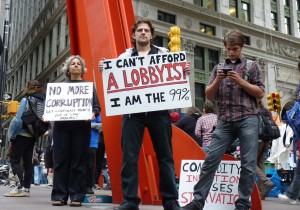
Pointing to the recent declines at the top, Mr. Kaplan argues the Occupy protesters have accused the wrong villain by focusing on inequality, which he called an inevitable byproduct of growth. “If you want to reduce inequality, all you need to do is put the economy in a recession,” he said. “If you want the economy to do well, as all of us do, then you’ll get more inequality.”Kaplan’s effort to link growth and economic inequality as inherently related is historically incorrect. For example, from 1950 to 1980, the share of income taken by the top 1% remained below 12% in all but one year, and was below 10% in 13 of those years. During that same time period, the US economy experience virtually uninterrupted growth. When the economy dipped in the early 1980s, the share of income taken by the top 1% increased. While it is true that most recessions lead to a decline in the share of income for the top 1%, the historical record does not support the contention that economic inequality is the inevitable byproduct of growth. In addition, while some level of inequality may be necessary for economic growth, elevated levels of inequality – such as those in the US today - actually stunt economic growth.
Monday, December 19, 2011
"Tax inequality"

An interesting, innovative idea for tax policy to stem the rising tide of income inequality, from law professors Aaron Edlin and Ian Ayres, HERE.
Sunday, December 18, 2011
Krugman on GOP Monetary Madness
Ron Paul's crank Gold Buggery is the new GOP "mainstream." Paul Krugman describes the descent into madness:
Mr. Paul identifies himself as a believer in “Austrian” economics — a doctrine that it goes without saying rejects John Maynard Keynes but is almost equally vehement in rejecting the ideas of Milton Friedman. For Austrians see “fiat money,” money that is just printed without being backed by gold, as the root of all economic evil, which means that they fiercely oppose the kind of monetary expansion Friedman claimed could have prevented the Great Depression — and which was actually carried out by Ben Bernanke this time around.
O.K., a brief digression: the Federal Reserve doesn’t actually print money (the Treasury does that). But the Fed does control the “monetary base,” the sum of bank reserves and currency in circulation. So when people talk about Mr. Bernanke printing money, what they really mean is that the Fed expanded the monetary base.
And there has, indeed, been a huge expansion of the monetary base. After Lehman Brothers fell, the Fed began lending large sums to banks as well as buying a wide range of other assets, in a (successful) attempt to stabilize financial markets, in the process adding large amounts to bank reserves. In the fall of 2010, the Fed began another round of purchases, in a less successful attempt to boost economic growth. The combined effect of these actions was that the monetary base more than tripled in size.

Austrians, and for that matter many right-leaning economists, were sure about what would happen as a result: There would be devastating inflation. One popular Austrian commentator who has advised Mr. Paul, Peter Schiff, even warned (on Glenn Beck’s TV show) of the possibility of Zimbabwe-style hyperinflation in the near future.
So here we are, three years later. How’s it going? Inflation has fluctuated, but, at the end of the day, consumer prices have risen just 4.5 percent, meaning an average annual inflation rate of only 1.5 percent. Who could have predicted that printing so much money would cause so little inflation? Well, I could. And did. And so did others who understood the Keynesian economics Mr. Paul reviles. But Mr. Paul’s supporters continue to claim, somehow, that he has been right about everything.
Thursday, December 15, 2011
The GOP candidates' plan to wreck the economy
Tim Dickinson at Rolling Stone on the GOP "Crazy":
 |
| The Little Rascals |
While threatening to slash the safety net for millions of Americans, the GOP candidates are also committed to a brutal austerity program that would tip the nation back into recession – if not a full-scale depression. The proposal in question is a constitutional amendment that would require the federal government to pass a balanced budget each year.Read Dickinson's complete "The GOP's Crackpot Agenda" HERE.
According to Macroeconomic Advisers, a top economic forecaster, balancing the budget in 2012 alone would throw 15 million Americans out of work, double unemployment to 18 percent and contract the U.S. economy by 17 percent. Going forward, the government would be barred from borrowing money during hard times to provide unemployment benefits, food stamps and other essential aid to those in need. As a result, the analysts report, "recessions would be deeper and longer." Even in times of plenty, a balanced-budget amendment would "retard economic growth" by increasing economic uncertainty – which Republicans have repeatedly blamed as the root of the current lackluster recovery.
Subscribe to:
Posts (Atom)