There is no issue where educated ignorance is on more perfect display than Post columnists, and Fox News All-Star panelists. They numbered among the select conservative intellectuals chosen to dine with newly elected president Barack Obama in 2009.
watching the conservative movement confront scientific evidence of climate change. Educated ignorance is not the same thing as the regular kind of ignorance. It takes real talent to master. George F. Will and Charles Krauthammer are two of the intellectual giants of the right, former winners of the Bradley Foundation’s $250,000 annual prize, Washington
On their Fox News All-Star Panel appearance this week, both men discussed the U.S. National Climate Assessment, which they dismissed with various irritable mental gestures. Their evasions and misstatements, clothed in faux-erudition, offer a useful entrance point to study the current state of the right-wing mind.

The Titanic sails at dawn - politics, economics & culture
Sunday, May 11, 2014
"All Science Is Wrong, Concludes Esteemed Fox News Panel"
Jonathan Chait at New York Magazine exposes the intellectual and moral bankruptcy of "conservatism's" foremost alleged "intellectuals." "Conservative intellectual" has truly become an oxymoron:


"Predictions and Prejudice" among that cohort of right-wing hacks posing as social scientists
Krugman @ NYT on the shame - or should I say "shamelessness" - of too many in his profession:
The 2008 crisis and its aftermath have been a testing time for economists — and the tests have been moral as well as intellectual. After all, economists made very different predictions about the effects of the various policy responses to the crisis; inevitably, some of those predictions would prove deeply wrong. So how would those who were wrong react?
The results have not been encouraging.Brad DeLong reads Allan Meltzer in the Wall Street Journal, issuing dire warnings about the inflation to come. Newcomers to this debate may not be fully aware of the history here, so let’s recap. Meltzer began banging the inflation drum five full years ago, predicting that the Fed’s expansion of its balance sheet would cause runaway price increases; meanwhile, some of us pointed both to the theory of the liquidity trap and Japan’s experience to say that this was not going to happen. The actual track record to date:Tests in economics don’t get more decisive; this is where you’re supposed to say, “OK, I was wrong, and here’s why”.Not a chance. And the thing is, Meltzer isn’t alone. Can you think of any prominent figure on that side of the debate who has been willing to modify his beliefs in the face of overwhelming evidence?Now, you may say that it’s always like this — but it isn’t. Consider the somewhat similar debate in the 1970s over the “accelerationist” hypothesis on inflation — the claim by Friedman and Phelps that any sustained increase in inflation would cause the unemployment-inflation relationship to worsen, so that there was no long-run tradeoff. The emergence of stagflation appeared to vindicate that hypothesis — and the great majority of Keynesians accepted that conclusion, modifying their models accordingly.So this time is different — and these people are different. And I think we need to try to understand why. Were the freshwater guys always just pretending to do something like science, when it was always politics? Is there simply too much money and too much vested interest behind their point of view?

Wednesday, April 30, 2014
The knives come out for Piketty...and they are pretty dull
Kathleen Geier outlines "What Piketty’s Conservative Critics Get Wrong" @ The Baffler:
With his book Capital in the Twenty-First Century, Thomas Piketty has lobbed a truth bomb that has blown up several decades’ worth of received opinion about the way the economy works in capitalist societies. He makes a powerful, meticulously-argued, data-driven case that inequality is a feature of capitalist economies, not a bug. Let to its own devices, wealth tends to become highly concentrated. The only events likely to prevent our society from plunging into a dystopian spiral of inequity are, on the one hand, certain rarely occurring catastrophes, such as war or depression; or, on the other, dramatic government intervention in the economy, in the form of steep taxes on the wealthy.
You can see why conservatives are going to be enraged by this book.
A conservative backlash to Piketty was inevitable; the only surprise is that it’s taken so long to develop. But in the last week or so, responses from the right have finally begun to roll in. Send in the clowns!

Tuesday, April 29, 2014
Recovery Has Created Far More Low-Wage Jobs Than Better-Paid Ones
Annie Lowrey @ NYT:
WASHINGTON — The deep recession wiped out primarily high-wage and middle-wage jobs. Yet the strongest employment growth during the sluggish recovery has been in low-wage work, at places like strip malls and fast-food restaurants.
In essence, the poor economy has replaced good jobs with bad ones. That is the
conclusion of a new report from the National Employment Law Project, a research and advocacy group, analyzing employment trends four years into the recovery.
“Fast food is driving the bulk of the job growth at the low end — the job gains there are absolutely phenomenal,” said Michael Evangelist, the report’s author. “If this is the reality — if these jobs are here to stay and are going to be making up a considerable part of the economy — the question is, how do we make them better?”
The report shows that total employment has finally surpassed its pre-recession level. “The good news is we’re back to zero,” Mr. Evangelist said.
But job losses and gains have been skewed. Higher-wage industries — like accounting and legal work — shed 3.6 million positions during the recession and have added only 2.6 million positions during the recovery. But lower-wage industries lost two million jobs, then added 3.8 million.
Most of the jobs added during the recovery have been in lower-wage industries...

Tuesday, April 22, 2014
U.S. is a world leader in class conflict over government spending
Political science Prof. Larry Bartels at WaPo:

(Data from International Social Survey Programme; tabulation by Larry Bartels)
The United States does less to redistribute income than virtually any other economically “advanced” democracy. So why does class conflict loom so much larger in U.S. public opinion about government spending than in other affluent democracies? The answer may have something to do with our peculiar system of taxation.
The claim that America is riven by class conflict may come as a surprise to people who like to think that “There are no classes in America,” as Rick Santorum put it during his 2012 presidential campaign. But the fact is that rich and poor Americans disagree about government spending to an extent virtually unmatched elsewhere in the world.
Monday, April 21, 2014
Saturday, April 19, 2014
Rand Paul is either an idiot or a calculated propagandist...or both
More Krugman on The Crazy:
I can easily understand it when people don’t know the facts about economic statistics; you need a fair bit of background knowledge even to know how to look these things up. It’s more surprising when people don’t know what they don’t know — when they make confident assertions that can be proved false in a few seconds by anyone who does know these things.
I had a one-on-one encounter with Rand Paul over such a case; there our heads were, talking on TV, and he insisted that government employment had risen under Obama. (It has actually plunged.) At the very least, you’d think he would have learned a lesson from the experience.
But no. There he goes, saying, "When is the last time in our country we created millions of jobs? It was under Ronald Reagan … "
Hmmm:

It’s not just that more jobs were created under Clinton, who raised taxes on the rich, than under Reagan; I wonder how many people know that more jobs were created under Jimmy Carter than under either Bush?
But I guess I really do understand it: according to right-wing theology, The Blessed Reagan’s tax cuts must have created far more jobs than the policies of evil redistributors. And so that’s what must have happened. Hey, Clinton was probably cooking the books.
Liberal Facts and "Conservative" Crazy
Krugman @ NYTs on The Crazy:
“The facts have a well-known liberal bias,” declared Rob Corddry way back in 2004 — and experience keeps vindicating his joke. But why?
Not long ago Ezra Klein cited research showing that both liberals and
conservatives are subject to strong tribal bias — presented with evidence, they see what they want to see. I then wrote that this poses a puzzle, because in practice liberals don’t engage in the kind of mass rejections of evidence that conservatives do. The inevitable response was a torrent of angry responses and claims that liberals do too reject facts — but none of the claims measured up.
Just to be clear: Yes, you can find examples where *some* liberals got off on a hobbyhorse of one kind or another, or where the liberal conventional wisdom turned out wrong. But you don’t see the kind of lockstep rejection of evidence that we see over and over again on the right. Where is the liberal equivalent of the near-uniform conservative rejection of climate science, or the refusal to admit that Obamacare is in fact reaching a lot of previously uninsured Americans?

The rich got richer
In what is beginning to sound like a "Dog Bites Man" story from the WSJ:
The rich got richer, the poor got poorer.
A recent article by Labor Department senior economist Aaron Cobet highlights the sharp disparity between the wealthiest and poorest Americans in the aftermath of the 2007-2009 recession.
“While average income has returned to pre-recession levels, income gains have been distributed unevenly,” Mr. Cobet said.
The economist mined Labor Department data to show that the top 20% of earners accounted for more than 80% of the rise in household income from 2008-2012. Income fell for the bottom 20%.
More "Capital in the 21st Century"
Martin Wolff reviews Thomas PIketty's opus @ The Financial Times. Read at link or below:
French economist Thomas Piketty has written an extraordinarily important book. Open-minded readers will surely find themselves unable to ignore the evidence and arguments he has brought to bear.
Karl Polyani Explains It All
Robert Kuttner has an excellent appreciation of the great critic of free market fundamentalism, Karl Polyani and his essential book, The Great Transformation, @ American Prospect:
The Great Transformation, written for a broad audience, is witty and passionate
as well as erudite. The prose is lyrical, despite the fact that English was Polanyi’s third language after Hungarian and German.

Contrary to libertarian economists from Adam Smith to Hayek, Polanyi argued, there was nothing “natural” about the free market. Primitive economies were built on social obligations. Modern commercial society depended on “deliberate State action” by and for elites. “Laissez-faire” he writes, savoring the oxymoron, “was planned.”
Libertarian economists, who treat the market as universal—disengaged from local cultures and historic time—are fanatics whose ideas end in tragedy. Their prescription means “no less than the running of society as an adjunct to the market. Instead of economy being embedded in social relations, social relations are embedded in the economic system.”
Like Marx, Polanyi begins in England, the first fully capitalist nation. In Polanyi’s telling, the slow shift from a post-feudal to a capitalist economic system accelerated in the 18th century, when the enclosure movement (“a revolution of the rich against the poor”) deprived the rural people of historic rights to supplement incomes by grazing domestic animals on common land, and the industrial revolution began to undermine craft occupations.
The Single Mother, Child Poverty Myth
This is an essential insight, given the dominant narrative about marriage, single-parenthood and poverty rampant not just among the usual suspects of the right but among many liberals.
Matt Breuning @ Demos:
I see it often claimed that the high rate of child poverty in the US is a function of family composition. According to this view, the reason childhood poverty is so high is that there are too many unmarried parents and single mothers, and those kinds of families face higher rates of poverty. The usual upshot of this claim is that we can't really do much about high rates of childhood poverty, at least insofar as we can't force people to marry and cohabitate and such.More here.
One big problem with this claim is that family composition in the US is not that much different from family compositions in the famed low-poverty social democracies of Northern Europe, but they don't have anywhere near the rates of child poverty we have.
A number of studies have tested this family composition theory using cross-country income data and found, again and again, that family composition differences account for very little of the child poverty differences between the US and other countries...

The Crisis of Long-Term Unemployment
Economic Policy Institute:
(L)ong-term unemployment is elevated for workers at every education level… while there is considerable variation in long-term unemployment rates across groups—which is always true, in good times and bad—the long-term unemployment rate is substantially higher now than it was before the recession started for all groups. The long-term unemployment rate is between 2.9 and 4.3 times as high now as it was six years ago for all age, education, occupation, industry, gender, and racial and ethnic groups. Today’s long-term unemployment crisis is not at all confined to unlucky or inflexible workers who happen to be looking for work in specific occupations or industries where jobs aren’t available. Long-term unemployment is elevated in every group, in every occupation, in every industry, at all levels of education.
Financial Transaction Tax Gains Traction
High-frequency trading accounts for roughly half of all stock market volume in the United States. Michael Lewis' recent book on the gaming of markets by high-frequency traders makes a financial transaction tax increasingly attractive. Nelson Schwartz @ NYTs:

It’s not every day that you find a fan club for new taxes, especially among economists and legal experts.
But a burst of outrage in recent days generated by Michael Lewis’s new book about the adverse consequences of high-frequency trading on Wall Street has revived support in some quarters for a tax on financial transactions, with backers arguing that a tiny surcharge on trades would have many benefits.
“It kills three birds with one stone,” said Lynn A. Stout, a professor at Cornell Law School, who has long followed issues of corporate governance and securities regulation. “From a public policy perspective, it’s a no-brainer.”
Not only would the tax reduce risk and volatility in the market, Professor Stout said, but it would also raise much-needed revenue for public coffers while making it modestly more expensive to engage in a practice that brings little overall economic benefit.
The "Too Big To Fail" Subsidy
David Dayen @ American Prospect:
Financial reformers in both parties have insisted for years that the largest banks remain too big to fail, and that Dodd-Frank did not cleanse the system of this reality. You can mark down this week as the moment that this morphed into conventional wisdom. In successive reports, two of the more small-c conservative economic institutions, without any history of agitating for financial reform—the Federal Reserve and the International Monetary Fund—both agreed that mega-banks, in America and abroad, enjoy a lower cost of borrowing than their competitors, based on the perception that governments will bail them out if they run into trouble. This advantage effectively works as a government subsidy for the largest banks, allowing them to take additional risks and threaten another economic meltdown. With institutional players like the Fed and the IMF both identifying the same problem, Wall Street grows more and more isolated, setting up the possibility of true reform.
Thursday, March 27, 2014
"Capital in the Twenty-first Century"
John Cassidy @ The New Yorker reviews the definitive new book on income inequality:
In the stately world of academic presses, it isn’t often that advance orders andpublicity for a book prompt a publisher to push forward its publication date. But that’s what Belknap, an imprint of Harvard University Press, did for “Capital in the Twenty-first Century,” a sweeping account of rising inequality by the French economist Thomas Piketty. Reviewing the French edition of Piketty’s book, which came out last year, Branko Milanovic, a former senior economist at the World Bank, called it “one of the watershed books in economic thinking.” The Economist said that it could change the way we think about the past two centuries of economic history. Certainly, no economics book in recent years has received this sort of attention...
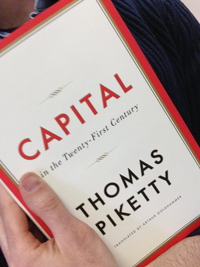
Piketty, who teaches at the Paris School of Economics, has spent nearly two decades studying inequality… The main task he set himself was exploring the hills and valleys of income and wealth, a subject that economics had largely neglected. At first, Piketty concentrated on getting the facts down, rather than interpreting them. Using tax records and other data, he studied how income inequality in France had evolved during the twentieth century, and published his findings in a 2001 book. A 2003 paper that he wrote with Emmanuel Saez, a French-born economist at Berkeley, examined income inequality in the United States between 1913 and 1998. It detailed how the share of U.S. national income taken by households at the top of the income distribution had risen sharply during the early decades of the twentieth century, then fallen back during and after the Second World War, only to soar again in the nineteen-eighties and nineties.
Monday, March 24, 2014
The widening productivity and income gap
Atif Mian and Amir Sufi @ House of Debt:
If you must know only one fact about the U.S. economy, it should be this chart:

The chart shows that productivity, or output per hour of work, has quadrupled since 1947 in the United States. This is a spectacular achievement by an advanced economy.
The gains in productivity were quite widely shared from 1947 to 1980. Real income for the median U.S. family doubled during this time just as output per hour of work performed doubled. The rising tide was lifting all boats.
(But there has been a) remarkable separation in productivity and median real income since 1980. While the United States is producing twice as much per hour of work today compared to 1980, a small part of the gain in real income has gone to the bottom half of the income distribution. The gap between productivity and median real income is at an historic all-time high today.
The Crime of 2010
Professor Krugman blogs this indictment of the Beltway, Business and Media Elites @ NYT. Millions of lives have been ruined by the cruelty of the Deficit Hawks, the willful ignorance or appalling timidity of insider DC elites - including many top Democrats - and the flaming idiocy of the TeaBaggers, who converged to force the country into an austerity discourse when the economy quite clearly needed a robust injection of federal spending:
(W)hat we’re learning from a number of sources: it’s really hard to get employers to look at people who have been out of work for an extended period, so any sustained increase in long-term unemployment tends to become permanent.
The best way to avoid this outcome, then, is to avoid prolonged periods of high unemployment.So let me make the obvious point, just in case anyone missed it: the “pivot” of2010 — when all the Very Serious People decided that the danger from debt trumped any and all concern for job creation — was an utter disaster, economic and human. It was even a disaster in fiscal terms, because a permanently depressed economy will cost far more in revenue than was saved by slashing the deficit by a few percent of GDP in the short term.
From the Annals of Deadly Expert Advice
Now, you might think that this post should be titled The Mistake of 2010 — but that would only be appropriate if it were truly an honest error. It wasn’t. Some of the austerians were self-consciously exploiting deficit panic to promote a conservative agenda; some were slipping into deficit-scolding rather than dealing with our actual problems because it felt comfortable; some were just going along for the ride, saying what everyone else was saying. Hardly anyone in the deficit-scold camp engaged in hard thinking and careful assessment of the evidence.

Sunday, March 23, 2014
The Tea Party "populists" are pushing Wall Streets's agenda
Mike Konczal @ TNR:
"Our problem today was not caused by a lack of business and bankingregulations,” argued Ron Paul in his 2009 manifesto End the Fed, which outlined a theory of the financial crisis that only implicated government policy and the Federal Reserve, while mocking the idea that Wall Street’s financial engineering and derivatives played any role. "The only regulations lacking were the ones that should have been placed on the government officials who ran roughshod over the people and the Constitution.” …

The Tea Party's theory of the financial crisis has absolved Wall Street completely. Instead, the crisis is interpreted according to two pillars of reactionary thought: that the government is a fundamentally corrupt enterprise trying to give undeserving people free stuff, and that hard money should rule the day. This will have major consequences for the future of reform, should the GOP take the Senate this fall.
On the Hill, it’s hard to find where the Tea Party and Wall Street disagree. Tea Party senators like Mike Lee, Rand Paul, and Ted Cruz, plus conservative senators like David Vitter, have rallied around a one-line bill repealing the entirety of Dodd-Frank and replacing it with nothing. In the House, Republicans are attacking new derivatives regulations, all the activities of the Consumer Financial Protection Bureau, the existence of the Volcker Rule, and the ability of the FDIC to wind down a major financial institution, while relentlessly attacking strong regulators and cutting regulatory funding. This is Wall Street’s wet dream of a policy agenda.
Saturday, March 15, 2014
Dooming the long-term unemployed via inflation hysteria
Matthew O'Brian @ The Atlantic:
Are the long-term unemployed just doomed today or doomed forever?
That's the question people are really asking when they ask if labor markets are
starting to get "tight." Now, it's hard to believe that this is even a debate when unemployment is still at 6.7 percent and core inflation is just 1.1 percent. But it is. The new inflation hawks argue that these headline numbers overstate how much slack is left in the economy. That the labor force is smaller than it sounds, because firms won't even consider hiring the long-term unemployed. That our productive capacity is lower than it sounds, because we haven't invested in new factories for too long. And that wages and prices will start rising as companies pay more for the workers and work that they want.
In other words, they think that the financial crisis has made us permanently poorer. That the economy can't grow as fast as it used to, so inflation will pick up sooner than it used to—and we need to get ready to raise rates. (Notice how that's always the answer no matter the question).
There are only two problems with this story: There's not much evidence for it, and we should ignore it even if there is. It's pretty simple. If tighter labor markets were causing wage inflation, they'd have caused wage inflation. But they haven't, not really. Now, it's true that average hourly earnings ticked up in February, but, as Paul Krugman points out, that was probably a weather-related blip. All the snow kept 6.8 million people from working full-time like they normally do, and, historically-speaking, that tends to affect hourly workers more than salaried ones. So higher-paid people probably made up a bigger share of the workforce last month—and voilà, it looked like wages rose. But that was just statistical noise, and if you look at the bigger picture, wage growth is still far below its pre-Lehman levels.

Subscribe to:
Posts (Atom)