Sunday, May 22, 2011

Clinging to the "strong dollar"

Now that she's no longer part of the Official Beltway gaggle, former White House economic advisor Christina Romer offers some straight talk on the "strong dollar" dogmatics:
"Won't you be my Teddy Bear?"
In November 2008, I was sharing a cab in Chicago with Larry Summers, the former Treasury secretary and a fellow economic adviser to the president-elect. To help prepare me for the interviews and the hearings to come, Larry graciously asked me questions and critiqued my answers.

When he asked about the exchange rate for the dollar, I began: “The exchange rate is a price much like any other price, and is determined by market forces.”

“Wrong!” Larry boomed. “The exchange rate is the purview of the Treasury. The United States is in favor of a strong dollar.”

For the record, my initial answer was much more reasonable. Our exchange rate is just a price — the price of the dollar in terms of other currencies. It is not controlled by anyone. And a high price for the dollar, which is what we mean by a strong dollar, is not always desirable.

Saturday, May 21, 2011

Gas and energy prices too high? Well, they're actually a lot higher than you think

David Leonhardt at the New York Times quotes Michael Greenstone and Adam Looney, economists at The Hamilton Project on the costs of American energy policy. They argue in a new study:
… our energy choices are based on the visible costs that appear on utility bills and at the gas pump. This system masks the social costs arising from those energy choices, including shorter lives, higher health care expenses, a changing climate, and weakened national security.
 Leonhardt further comments:
Mr. Greenstone and Mr. Looney estimate that a coal plant must spend 3.2 cents to produce a kilowatt hour of electricity (and consumers then pay slightly more than this). This price appears to be a bargain, the economists write, but the true costs (of our carbon energy) — once health costs, military costs and the like are taken into account — are more than twice as high: 8.8 cents per kilowatt hour.
Real costs of current energy consumption must be factored into any strategy for funding research and creating viable markets for green energy.  When people complain about things like gas prices at the pump, they're not even close to understanding the actual costs involved in our energy markets.

Friday, May 20, 2011

From "deficits don't matter" to "defaults don't matter"

Conservative David Frum on the state of his party:
We’ve evolved in the space of a decade from “deficits don’t matter” to “defaults don’t matter.”
It seems flabbergasting that a conservative party could arrive at this destination.

Yet the new mood exemplifies the trend we have seen over the past three decades, whereby one after another the “rules of the game” have been discarded...

And now even the debts and obligations of the United States become a tool of politics.

Everybody seems to assume that the rules will be reasserted before the game gets too dangerous. Maybe. Let’s hope. But one year’s outrageous innovation has a bad habit of becoming next year’s new normal.

Thursday, May 19, 2011

The graph that gives the lie to GOP arguments about the economic impact of tax increases vs. tax cuts


It's no secret that job growth and GDP growth were strong in the years after President Clinton increased taxes to curb deficits and get the government on sounder fiscal footing,  and that George W. Bush presided over a remarkably weak economy after making tax cuts the centerpiece of his economic program.  But that doesn't stop Republicans from spinning fantastical tales of the inevitable and terrible consequences of even modest tax increases to curb long-term deficits.

The truth is that tax cuts are ideology - rather than pragmatic policy - in GOP circles and have the aura of creationism for religious fundamentalists.  I don't really care what religious fundamentalists believe happened millions, or in their view thousands, of years ago - as long as they don't try to sell it as "science" in the schools.  But for contemporary "conservatives" posing as "deficit hawks" to make arguments about tax cuts that are based solely on a belief system, rather than what we know - at least in terms of co-relation - about our economy and fiscal trajectory over the past 20 years is a signal of just how un-serious they are about fiscal sanity and balancing budgets. 

An irrational, counter-factual article of faith - rooted in the disastrous "Starve the Beast" anti-government ideology - drives one of our political parties.  And driven by that dogma, they're willing to drive the country off a cliff.

Via Ezra Klein, Wonkbook.

Wednesday, May 18, 2011

Jobs? Who cares?

Although polling shows the public is much more concerned about unemployment than deficits, the mainstream press has dutifully fallen into line with the GOP's Beltway-driven deficit-hysterics agenda in their coverage of the issues.

From Derek Thompson at The Atlantic:
Articles mentioning unemployment have plummeted nearly 70 percent since last summer, while articles mentioning the deficit have doubled over the same time, according to a National Journal report.

Is this pernicious Beltway loopism? Maybe. But more likely it's the inevitable result of an election that punished stimulus-happy Democrats and opened the doors wide for Republicans who promised to focus with maniacal intensity on the deficit. The 2010 election reshaped Congress, the Congress reshaped the jobs-and-deficit debate, and press coverage shifted to the deficit.

Meanwhile, remember how we have 9 percent unemployment? It's true. We have 9 percent unemployment, according to the most conservative definition of unemployment, and tens of millions of Americans are stuck on the outside of the job market looking in.
 Here's the chart, showing press coverage tracking the concerns of Washington over those of Main Street:

Tuesday, May 17, 2011

Poor Paul Ryan

Quote of the day: 
Remember, as far as the political world is concerned, Paul Ryan is the best Republicans have to offer. He’s not some random back-bencher; he’s the GOP’s go-to guy on fiscal issues.
And yet, Ryan’s agenda is basically an arithmetic-challenged fraud, and he apparently has no idea what the “the drivers of our debt” are.
 Read Steve Benen's piece on the latest fantastical assertions from Mr. Ryan HERE.

The best economists money can buy

Illustration from Paul Krugman's "How Did Economists Get It So Wrong?"

According to Nancy Folbre, an economics professor at U Mass-Amherst writing for The New York Times "Economix" blog, her profession is being gamed by right-wing money men who are buying influence within universities to validate their political agenda:
If you don’t like what economics professors like me are saying, go hire your own. Of course, if they’re on your payroll, no one will be surprised if they agree with you, so it’s best to hire them indirectly, through a tied donation to a university.

Frustrated that so few students are reading your favorite book about the virtues of free enterprise? Offer highly respected universities money to make it required reading.
As Catherine Rampell pointed out in Economix last week, conservative foundations founded by Charles Koch and John Allison have actively pursued such strategies.

Monday, May 16, 2011

Kenyan Socialist President to GOP "Fiscal Conservatives" on the dangers of not raising the debt limit

What would Reagan do?
“The full consequences of a default – or even the serious prospect of default – by the United States are impossible to predict and awesome to contemplate. Denigration of the full faith and credit of the United States would have substantial effects on the domestic financial markets and the value of the dollar.”

Oh wait a minute. That was Ronald Reagan telling Congress what was at stake back in 1983.

Via Steve Benen/Washington Monthly.

Sing it again Woody: "Some people rob you with a six-gun..."

"Some rob you with a fountain pen!"


Shahien Nasiripour at Huffington Post:
Woody Guthrie sings at McSorley's, NYC


"Federal Audits Accuse Five Biggest Mortgage Firms Of Defrauding Taxpayers"


Read the whole thing, HERE.

Tax cut kool-aid

Our favorite conservative economist, Bruce Bartlett, explains the fraud that is GOP fiscal policy and suggests it's starting to unravel:
The flavor of GOP fiscal policies.
Republicans have a problem. The American people are concerned about the budget deficit and know enough basic arithmetic to understand that it can result from higher spending or lower revenues. Republicans, however, insist that taxes must not be increased by a single penny; indeed, they argue that the government doesn’t even have a deficit problem, just a spending problem. Therefore, the only deficit reduction measures they will consider in the Republican-controlled House of Representatives are spending cuts. So certain are Republicans that tax cuts have no impact on the deficit that they included another $3 trillion worth in the budget they passed on April 15.

Democrats all know that the Republican position is ridiculous, that the Bush tax cuts have added some $2 trillion to the national debt and constitute the largest component of projected deficits going forward. These facts are documented in recent reports from the Congressional Budget Office, Pew Charitable Trusts, and the Center on Budget and Policy Priorities. They show that simply allowing all the Bush tax cuts to expire on schedule next year would be sufficient, by itself, to stabilize the debt-to-GDP ratio.

Unfortunately, Democrats have been oddly reluctant to explain the truth about the deficit. They seem paralyzed by fear that they will be attacked by Republicans for being tax increasers. Consequently, the Republican mantra that spending must be slashed, even if it means effectively abolishing Medicare, and any tax increase, no matter how small, will destroy the economy is just about the only budget option voters ever hear.

Big Spender

The hypocrisy of the GOP on deficit issues is manifest - most especially given their "Starve the Beast" tax-cut ideology over 30 years that deliberately underfunded government in order to create the kind of "deficit crisis" that they are currently using in their arsenal of shameless demagogy to kill government programs.  What is often less apparent is their big-spending hypocrisy.

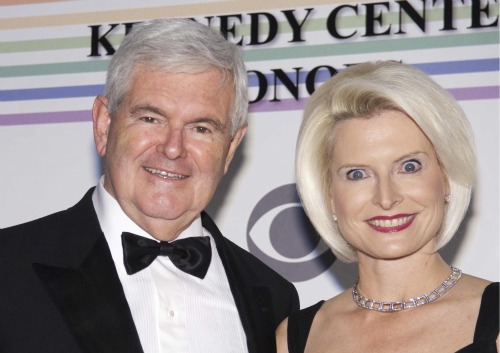
Newt and the Mistress Missus
Current Presidential aspirant Newt Gingrich - who has unleashed the "big spender" attack on President Obama (actually one of his least obnoxious assertions about the President, but let's leave the pure nutso stuff like "Kenyan Socialist" out of this, if only to control my blood pressure) - is a case in point. Think Progress has the goods on this disingenuous character, whose combination of grotesque pretensions, egomania and lack of self-awareness rival perhaps only Donald Trump's in the GOP's "Presidential" over-stuffed Clown Car of wannabe candidates:
(A)s Speaker of the House of Representatives in the 1990′s, he himself was one of the most avid big spenders in the entire country, using government cash to enrich his district and lift it up to being one of the wealthiest in the country.
During his tenure in Congress, Gingrich represented large portions of Cobb County, Georgia. Cobb was a mostly-white district and largely suburban — completely different from the crude stereotypes Gingrich and others used to blast the welfare state, which were generally portrayed as minority-heavy urban environments. At the same time Gingrich was working with President Bill Clinton to cut back on spending for programs for the poorest Americans, Gingrich made Cobb one of the most subsidized districts in the entire country.
A 1996 article from New York Magazine notes this:
[Gingrich] represents Cobb County, a prosperous jurisdiction that ranks third among suburban counties in federal dollars returned per resident. According to the Atlanta Journal-Constitution, the federal government spent $4.4 billion in Cobb County in 1994, some $10,000 per resident, or nearly twice as much per capita as it spent in New York City.

Saturday, May 14, 2011

Krugman and Klein on the ugly politics of the debt ceiling

Paul Krugman explains at his NYTs blog just what the fight over the debt ceiling means, in direct effects but more importantly in political terms, which mostly signal just how extremist the allegedly "conservative" faction in our governing system has become and how the most basic measures to ensure stability are nothing but partisan politics for the GOP:
The direct effects of hitting the ceiling would be bad enough — sharp cutbacks in spending, which would undermine essential services, not to mention derail the economy. It’s not clear to me whether there would be some wiggle room through the accumulation of arrears — say, not actually paying workers and contractors but promising to make it up when sanity returns. But it would be ugly indeed.

What might make it even worse would be indirect effects, of two kinds.

First, US government debt plays a special role in the financial system: T-bills are the universal safe asset, the ultimate collateral. That’s why, during moments of financial stress, the interest rate on T-bills has actually gone negative. Make that safe asset suddenly unsafe, and it might cause vast disruption.

Second — and I don’t think this is getting enough attention — failure to raise the debt limit could act as a terrible signal about the US political system.
When you look at the US fiscal position in terms of what we’re capable of as a nation, it’s not a big problem. Never mind those big numbers you hear about implicit liabilities; we have a big economy, too. So modest tax increases and reasonable efforts to limit health care costs could bring our long-run finances into line.

But all this depends on our having the political will and cohesion to do what’s necessary. What if it turns out that we’re a banana republic, with crazy extremists having so much blocking power that we can’t get our house in order?

Friday, May 13, 2011

Democratic budget proposal


The Hill has a piece up suggesting that Democrats are including a "millionaires' surtax" of 3% in their budget proposal.  A start...read it HERE.

Thursday, May 12, 2011

Tax cut voodoo...

Once more with feeling:  Current and projected deficits are primarily the result of Republican tax cut dogmas that they cling to like a religion and push on the public like patent medicine, even in the face of all evidence that they have failed as fiscal  policy. Returning to rational taxation by, as a first step, letting the Bush tax cuts expire is the best path to restoring balance in federal budgets.  More tax cuts, as proposed by the GOP in their budget proposals, are an utter fraud as "fiscal conservatism" and benefit no one but the economic elite.

From the Center on Budget and Policy Priorities:

Who needs Medicare?  We've got magic tax cuts!
Some lawmakers, pundits, and others continue to say that President George W. Bush’s policies did not drive the projected federal deficits of the coming decade — that, instead, it was the policies of President Obama and Congress in 2009 and 2010. But, the fact remains: the economic downturn, President Bush’s tax cuts and the wars in Afghanistan and Iraq explain virtually the entire deficit over the next ten years...

The deficit for fiscal year 2009 — which began more than three months before President Obama’s inauguration — was $1.4 trillion and, at 10 percent of Gross Domestic Product (GDP), the largest deficit relative to the economy since the end of World War II. At $1.3 trillion and nearly 9 percent of GDP, the deficit in 2010 was only slightly lower. If current policies remain in place, deficits will likely resemble those figures in 2011 and hover near $1 trillion a year for the next decade…

The key question is: where do we go from here? It’s too late to undo the damage caused by the tax cuts and wars over the last decade, which have left us with a large overhang of debt. (In fact, that debt legacy — and the resulting interest costs — are a key reason, along with an aging population and rising health-care costs, that it’s unrealistic and ill-advised to restrict total federal spending to the average outlay levels that prevailed over the 1970-2008 period, as some have proposed.) But it’s feasible to enact measures now — to take effect once the economy has recovered more fully — that would put the budget on a sustainable path without jeopardizing the economic recovery.

Wednesday, May 11, 2011

I'm not an economist, but...

This argument from Brad DeLong regarding the value of a bit of inflation under current circumstances strikes me as sensible:
The Inflation Equation: Creditors vs. Debtors
My great uncle Phil from Marblehead Massachusetts used to talk about a question on a sailing safety examination he once took: "What should you do if you are caught on a lee shore in a hurricane?" The correct answer was: "You never get caught on a lee shore in a hurricane!" The answer to the question of what you should do when conventional monetary policy is tapped out and you are at the zero interest rate nominal bound is that you should never get in such a situation in the first place.
How can you minimize the chances that an economy gets caught at the zero nominal bound where short-term Treasury bonds and cash are perfect substitutes and conventional open-market operations have no effects? The obvious answer is to have a little bit of inflation in the system: not enough to derange the price mechanism, but enough to elevate nominal interest rates in normal times, so that monetary policy has plenty of elbow room to take the steps it needs to take to create macroeconomic stability when recession threatens. We want "creeping inflation."
How much creeping inflation do we want? We used to think that about 2% per year was enough. But in the past generation major economies have twice gotten themselves stranded on the rocks of the zero nominal bound while pursuing 2% per year inflation targets. First Japan in the 1990s, and now the United States today, have found themselves on the lee shore in the hurricane.
That strongly suggests to me that a 2% per year inflation target is too low. Two macroeconomic disasters in two decades is too many.

Tuesday, May 10, 2011

Frederich Hayek - another damned socialist?

"If you haven't read Atlas Shrugged, read this..."
Frederich Hayek is one of the patron saints of anti-government types who posit the "free market" as solution to any and every problem.  He is considered the Anti-Keynes in the history of 20th century economic thought.

As measure of Hayek's contemporary place in our political discourse, the government-hating nutcase Glenn Beck is credited for ramping up Hayek's Amazon ratings to #1 simply by devoting several shows to some FOXified version of the dead Austrian's economic theories - although this factoid is hardly fair to Hayek himself in it's implications of raving anti-intellectualism and lack of even the most modest aspirations to analytical integrity.

But from recovering neo-conservative Francis Fukayama, who reviewed "The Constitution of Liberty," one of Hayek's major works, for the New York Times Book Review over the weekend, we get this footnote to Hayek's insistent case for the superiority of markets:
It may...surprise some of Hayek’s new followers to learn that “The Constitution of Liberty” argues that the government may need to provide health insurance and even make it ­compulsory .
Surprise?  My sense of the current aggressive ignorance and emotional discombobulation among the Tea Party, Hyper-Foxoid right-wing is that if Glenn Beck and his minions got wind of that rather stunning "caveat" to Hyek's anti-government case, he'd add Hayek to his list of folks out to destroy America!

Monday, May 9, 2011

Quote of the Day

"The fact is that what we’re experiencing right now is a top-down disaster. The policies that got us into this mess weren’t responses to public demand. They were, with few exceptions, policies championed by small groups of influential people — in many cases, the same people now lecturing the rest of us on the need to get serious. And by trying to shift the blame to the general populace, elites are ducking some much-needed reflection on their own catastrophic mistakes..."

Paul Krugman in his NYT column today - "The Unwisdom of Elites." Read the whole piece HERE.

The cost of killing Medicare...

Where are those Tea Party protestors now?


Congressman George Miller has released a report by the Center for Economic and Policy Research that found a 54-year-old today would need $182,000 in additional savings at retirement just to pay for the cost of maintaining full health coverage to age 84 under the Congressional GOP's plan to eliminate Medicare.