These past few years have been lean times in many respects — but they’ve been boom years for agonizingly dumb, pound-your-head-on-the-table economic fallacies. The latest fad — illustrated by this piece in today’s WSJ — is that expansionary monetary policy is a giveaway to banks and plutocrats generally. Indeed, that WSJ screed actually claims that the whole 1 versus 99 thing should really be about reining in or maybe abolishing the Fed. And unfortunately, some good people... have bought into at least some version of this story.
What’s wrong with the idea that running the printing presses is a giveaway to plutocrats? Let me count the ways.

The Titanic sails at dawn - politics, economics & culture
Friday, April 20, 2012
The virtues of expansionary monetary policy
Professor Krugman, at his NYT blog:


Tuesday, April 17, 2012
Happy Tax Day!
From American Prospect and Demos:
1. The government has collected less in taxes as a proportion of the economy in the past three years than it has in any three-year period since World War II, and tax rates are at historic lows.
2. One out of three multi-millionaires pays a lower percentage of their income in taxes than the vast majority of people making $60,000 a year.
3. Chairman Paul Ryan’s budget proposal, which has been praised by Governor Romney, would deliver benefits to people with incomes over $1 million that are 10 times greater than the benefits to those earning $40,000 or less.

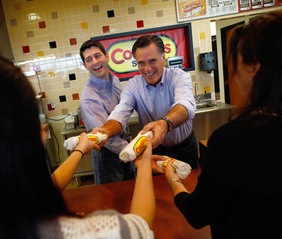
Mitt declares his stay-at-home wife Ann "lackng the dignity of work"
"Big news week" for FOX, GOP hacks and a desperate Romney campaign boils down to a Hypocrites' Kerfuffle. Up w/ Chris Hayes has it:
Visit msnbc.com for breaking news, world news, and news about the economy
Europe's Disastrous Austerity Strategy
Paul Krugman expresses deep, deep misgivings about Europe's chances to avert even worse economic calamity:
Just a few months ago I was feeling some hope about Europe. You may recall that late last fall Europe appeared to be on the verge of financial meltdown; but the European Central Bank, Europe’s counterpart to the Fed, came to the Continent’s rescue. It offered Europe’s banks open-ended credit lines as long as they put up the bonds of European governments as collateral; this directly supported the banks and indirectly supported the governments, and put an end to the panic.The question then was whether this brave and effective action would be the start of a broader rethink, whether European leaders would use the breathing space the bank had created to reconsider the policies that brought matters to a head in the first place.But they didn’t. Instead, they doubled down on their failed policies and ideas. And it’s getting harder and harder to believe that anything will get them to change course.

Saturday, April 14, 2012

Friday, April 13, 2012
Occupy Wall Street (1765 Edition)
Letter to the New York Gazette, 1765 that shows the "We Are the 99%" Movement to be as American as apple pie:
"Some Individuals of our Countrymen, by the Smiles of Providence or some other Means, are enabled to roll in their four–wheel'd Carriages, and can support the Expence of good Houses, rich Furniture, and Luxurious Living. But, is it equitable that 99, or rather 999 should suffer for the Extravagance or Grandeur of one? Especially when it is consider’d, that Men frequently owe their Wealth to the Impoverishment of their Neighbours."

Pres. Obama makes Wall Street's "enemies list" - Good for him!
Bill Moyers and Michael Winship @ Salon:
Benjamin Franklin, who used his many talents to become a wealthy man, famously said that the only things certain in life are death and taxes. But if you’re a corporate CEO in America today, even they can be put on the back burner – death held at bay by the best medical care money can buy and the latest in surgical and life extension techniques, taxes conveniently shunted aside courtesy of loopholes, overseas investment and governments that conveniently look the other way.
In a story headlined, “For Big Companies, Life Is Good,” the Wall Street Journal reports that big American companies have emerged from the deepest recession since World War II more profitable than ever: flush with cash, less burdened by debt, and with a greater share of the country’s income. But, the paper notes, “Many of the 1.1 million jobs the big companies added since 2007 were outside the U.S. So, too, was much of the $1.2 trillion added to corporate treasuries.”

To add to this embarrassment of riches, the consumer group Citizens for Tax Justice reports that more than two dozen major corporations — including GE, Boeing, Mattel and Verizon — paid no federal taxes between 2008 and 2011. They got a corporate tax break that was broadly supported by Republicans and Democrats alike.
Corporate taxes today are at a 40-year-low — even as the executive suites at big corporations have become throne rooms where the crown jewels wind up in the personal vault of the CEO.
Then look at this report in The New York Times: Last year, among the 100 best-paid CEOs, the median income was more than 14 million, compared with the average annual American salary of $45,230. Combined, this happy hundred executives pulled down more than two billion dollars.
What’s more, according to the Times “… these CEO’s might seem like pikers. Top hedge fund managers collectively earned $14.4 billion last year.” No wonder some of them are fighting to kill a provision in the recent Dodd-Frank reform law that would require disclosing the ratio of CEO pay to the median pay of their employees. One never wishes to upset the help, you know. It can lead to unrest.
That’s Wall Street — the metaphorical bestiary of the financial universe. But there’s nothing metaphorical about the earnings of hedge fund tigers, private equity lions, and the top dogs at those big banks that were bailed out by tax dollars after they helped chase our economy off a cliff.
So what do these big moneyed nabobs have to complain about? Why are they whining about reform? And why are they funneling cash to super PACs aimed at bringing down Barack Obama, who many of them supported four years ago?
Thursday, April 12, 2012
"Helping the Poor is Now Apparently Anti-Bible"
Kevin Drum @ Mother Jones questions the priorities of best-selling gasbag Rev. Rick, as the Purpose Driven One bats down a ridiculous straw man while not-so-faintly echoing a GOP talking point:
Rick Warren — he of Saddleback megachurch and Purpose Driven Life fame — is in the news again. He was on ABC's This Week...and Jake Tapper asked him what he thought about President Obama's suggestion that God tells us to care for those less fortunate than ourselves:
"Dogs? Yes, but no Jews!"
Well certainly the Bible says we are to care about the poor....But there's a fundamental question on the meaning of "fairness." Does fairness mean everybody makes the same amount of money? Or does fairness mean everybody gets the opportunity to make the same amount of money? I do not believe in wealth redistribution, I believe in wealth creation.

The only way to get people out of poverty is J-O-B-S. Create jobs. To create wealth, not to subsidize wealth. When you subsidize people, you create the dependency. You — you rob them of dignity.
Tuesday, April 10, 2012
More Ginned Up Hysterics About a Fake "Entitlement Crisis"
Today's column by Robert Samuelson tries to tell us that Franklin Roosevelt would be appalled by the current state of the Social Security program. Of course, he produces not a single iota of evidence to support this position, although it is very clear that Samuelson doesn't like Social Security.
Deep Thinker!

Samuelson begins by telling us that:
"It [Social Security] has become what was then called 'the dole' and is now known as 'welfare.' This forgotten history clarifies why America’s budget problems are so intractable."He later adds:
"Millions of Americans believe (falsely) that their payroll taxes have been segregated to pay for their benefits and that, therefore, they 'earned' these benefits. To reduce them would be to take something that is rightfully theirs."Of course Samuelson is 100 percent wrong here. Payroll taxes have been segregated. That is the point of the Social Security trust fund and the Social Security trustees report. These institutions would make no sense if the funds were not segregated.
On closer examination...
Samuelson is welcome to not like the way in which the funds were segregated, in the same way that I don't like the Yankees, but that doesn't change the fact that the Yankees have a very good baseball team. Since its beginnings, the government has maintained a separate Social Security account. Under the law, no money can be paid out in Social Security benefits unless the Trust Fund has the money to pay for them.
In this sense, the funds are absolutely segregated. Samuelson doesn't like this, but why should any of the rest of us care? The rest of the piece shows the same dishonesty and lack of respect for facts.

Monday, April 9, 2012
"Welfare Limits Left Poor Adrift as Recession Hit"
Jason DeParle at NYTs:
Perhaps no law in the past generation has drawn more praise than the drive to “end welfare as we know it,” which joined the late-’90s economic boom to send caseloads plunging, employment rates rising and officials of both parties hailing the virtues of tough love.
But the distress of the last four years has added a cautionary postscript: much as overlooked critics of the restrictions once warned, a program that built its reputation when times were good offered little help when jobs disappeared. Despite the worst economy in decades, the cash welfare rolls have barely budged.
Faced with flat federal financing and rising need, Arizona is one of 16 states that have cut their welfare caseloads further since the start of the recession — in its case, by half. Even as it turned away the needy, Arizona spent most of its federal welfare dollars on other programs, using permissive rules to plug state budget gaps.
The poor people who were dropped from cash assistance here, mostly single mothers, talk with surprising openness about the desperate, and sometimes illegal, ways they make ends meet. They have sold food stamps, sold blood, skipped meals, shoplifted, doubled up with friends, scavenged trash bins for bottles and cans and returned to relationships with violent partners — all with children in tow.
Esmeralda Murillo, a 21-year-old mother of two, lost her welfare check, landed in a shelter and then returned to a boyfriend whose violent temper had driven her away. “You don’t know who to turn to,” she said.

Saturday, April 7, 2012
The GOP's "Ryan Budget" - cynicism in service to the 1%

I'm very supportive of the Ryan budget plan. It's a bold and exciting effort on his part and on the part of the Republicans...I applaud it. It's an excellent piece of work and very much needed.Paul Krugman:
You can learn everything you need to know (about the Ryan/GOP budget) by understanding two numbers: $4.6 trillion and 14 million. Of these, $4.6 trillion is the size of the mystery meat in the budget. Ryan proposes tax cuts that would cost $4.6 trillion over the next decade relative to current policy — that is, relative even to making the Bush tax cuts permanent — but claims that his plan is revenue neutral, because he would make up the revenue loss by closing loopholes. For example, he would … well, actually, he refuses to name a single example of a loophole he wants to close.
So the budget is a fraud. No, it’s not “imperfect”, it’s not a bit shaky on the numbers; it’s completely based on almost $5 trillion dollars of alleged revenue that are pure fabrication.
On the other side, 14 million is the minimum number of people who would lose health insurance due to Medicaid cuts — the Urban Institute, working off the very similar plan Ryan unveiled last year, puts it at between 14 and 27 million people losing Medicaid.
That’s a lot of people — and a lot of suffering. And again, bear in mind that none of this would be done to reduce the deficit — it would be done to make room for those $4.6 trillion in tax cuts, and in particular a tax cut of $240,000 a year to the average member of the one percent..
Thursday, April 5, 2012
Wednesday, April 4, 2012
"Thinly veiled Social Darwinism"
President Obama on the GOP's "Ryan Budget":
In this country, broad-based prosperity has never trickled down from the success of a wealthy few. It has always come from the success of a strong and growing middle class.
That’s how a generation who went to college on the G.I. Bill, including my grandfather, helped build the most prosperous economy the world has ever known. That’s why a CEO like Henry Ford made it his mission to pay his workers enough so they could buy the cars that they made. That’s why research has shown that countries with less inequality tend to have stronger and steadier economic growth over the long run.
And yet, for much of the last century, we have been having the same argument with folks who keep peddling some version of trickle-down economics. They keep telling us that if we’d convert more of our investments in education and research and health care into tax cuts -- especially for the wealthy -- our economy will grow stronger. They keep telling us that if we’d just strip away more regulations, and let businesses pollute more and treat workers and consumers with impunity, that somehow we’d all be better off. We’re told that when the wealthy become even wealthier, and corporations are allowed to maximize their profits by whatever means necessary, it’s good for America, and that their success will automatically translate into more jobs and prosperity for everybody else. That’s the theory.
Now, the problem for advocates of this theory is that we’ve tried their approach -- on a massive scale. The results of their experiment are there for all to see.
Monday, April 2, 2012
A Rightist Ideological Coup Under Cover of "Conservatism"
E. J. Dionne on the prevalence of far-right extremism among today's "conservatives" and the moral duty of self-annointed "centrists":
A brief look at history suggests how far to the right both the Republican Party and contemporary conservatism have moved. Today’s conservatives almost never invoke one of our most successful Republican presidents, Dwight D. Eisenhower, who gave us, among other things, federally guaranteed student loans and championed the interstate highway system.
Even more revealing is what Robert A. Taft, the leader of the conservative forces who opposed Eisenhower’s nomination in 1952, had to say about government’s role in American life. “If the free enterprise system does not do its best to prevent hardship and poverty,” the Ohio Republican senator said in a 1945 speech, “it will find itself superseded by a less progressive system which does.” He urged Congress to “undertake to put a floor under essential things, to give all a minimum standard of decent living, and to all children a fair opportunity to get a start in life.”
Who can doubt that today’s right would declare his day’s Mr. Republican and Mr. Conservative a socialist redistributionist?
If our nation’s voters want to move government policy far to the right, they are entirely free to do so. But those who regard themselves as centrist have a moral obligation to make clear what the stakes are in the current debate. If supposed moderates refuse to call out the new conservatism for the radical creed it has become, their timidity will make them complicit in an intellectual coup they could have prevented.

"There’s very little the federal government has done over the past 150 years...that the House Republicans approve of"
James Suroweicki at The New Yorker:
Last week, when House Republicans passed Paul Ryan’s budget resolution, Ryan, the Budget Committee chairman, said that Congress had a “moral obligation” to get the country’s finances under control, and that the vote was a necessary response to a looming “debt-driven crisis.” What he didn’t mention was that it was also a vote to gut the federal government...
"...the worst of times."
It’s a profoundly radical document, its proposals skewed by ideological biases. Raising taxes, of course, is out of bounds. The same goes for using federal power to hold down Medicare costs, which will be the key driver of future budget deficits. Instead, House Republicans would cut spending on almost everything else the government does. According to an analysis by the Congressional Budget Office, the Ryan plan would, by 2050, reduce federal spending to its lowest point, as a percentage of G.D.P., since 1951. And since an aging population, with rising health-care costs, means that a hefty chunk of government spending will be going to retirement and health-care benefits, hitting Ryan’s target would require drastically shrinking everything else.

Mr. Krugman respectfully disagrees with the House Republicans
 |
| "Do I really have to swallow this stuff?" |
"The most fraudulent budget in American history...mystery meat...pink slime... House Republicans have just demonstrated, as clearly as anyone could wish, that they are neither (responsible nor honest.)"
Ouch!
Read Nobel Economist and Times columnist Paul Krugman's complete evisceration of the GOP/Ryan Budget HERE.
Sunday, April 1, 2012
"Reaganism" wouldn't pass muster in today's extremist GOP right
 |
| A Cardboard Reagan for the Ages |
David Savage at LA Times:
When the incoming Chief Justice John G. Roberts Jr. came before the Senate for confirmation seven years ago, President Reagan's solicitor general gave him a warm endorsement as a "careful, modest" judge.
"He's not a man on a mission," Harvard Law professor Charles Fried testified, adding that Roberts was not likely "to embark on constitutional adventures."
But two years ago, the Roberts-led Supreme Court struck down the federal and state laws that for a century had barred corporations and unions from pouring money into election campaigns.
And last week, the court's conservatives, including Roberts, suggested they may well strike down President Obama's healthcare law as unconstitutional. If so, it would be the first time since 1936 that the Supreme Court voided a major federal regulatory law.
"Wall Street's Risky Business"
Great segment from "Up w/ Chris Hayes" on the degenerate culture
of the upper echelons of "our" financial sector:
of the upper echelons of "our" financial sector:
"How to Prevent a Financial Overdose"
Gretchen Morgenson at NYT:
THE Food and Drug Administration vets new drugs before they reach the market. But imagine if there were a Wall Street version of the F.D.A. — an agency that examined new financial instruments and ensured that they were safe and benefited society, not just bankers.
How different our economy might look today, given the damage done by complex instruments during the financial crisis.
And yet, four years after the collapse of Bear Stearns, regulation of these products remains a battleground. As federal officials struggle to write rules required by the Dodd-Frank law, some in Congress are trying to circumvent them. Last week, for instance, the House Financial Services Committee approved a bill that would let big financial institutions with foreign subsidiaries conduct trades that evade rules intended to make the vast market in derivatives more transparent.

Friday, March 30, 2012
Night of the Living Oil Subsidies
Chris Hayes, subbing for Rachel Maddow, on the GOP's filibuster to save the wildly unpopular tax subsidies to Big Oil that virtually no one can openly defend:
Thursday, March 29, 2012
"No, the affordable housing push didn’t cause the subprime crisis"
Once more - Suzy Khimm at Wonkblog:
It’s one of the biggest misconceptions about the housing crisis: the belief that the government’s policies to promote affordable housing — particularly through Fannie Mae and Freddie Mac — fanned the flames of the subprime mortgage market, ultimately bringing down the entire economy.
In fact, a growing body of independent research confirms that it wasn’t the affordable housing mandate that led to the proliferation of risky mortgages. And the most recent evidence comes from the St. Louis Federal Reserve Bank.
Over the past few decades, the federal government has tried to promote affordable housing in two major ways. First, the Community Reinvestment Act encouraged banks to lend to low-income communities. Second, Congress mandated that Fannie and Freddie hit certain targets for lending to low-income and minority communities.
Researchers from the St. Louis Fed analyzed whether such policies “influenced origination or affected prices of subprime mortgages.” While they confirmed that Fannie and Freddie did make widespread purchases of risky, mortgage-backed securities, they conclude that such moves were not, in fact, the result of these affordable housing mandate.

Wednesday, March 28, 2012
Will the Supremes' ruling on "Obamacare" be pure politics?
David Leonhardt at New York Times:
Many legal scholars, including some conservatives, have been predicting that the Supreme Court will uphold the 2010 health care overhaul. But after Tuesday’s arguments, when several justices asked skeptical questions about the heart of the law, a political lens seemed relevant, too.When Congress passed the law, 9 out of 10 Democrats voted for it, while not a single Republican, in either the House or the Senate, did so. In the lower courts, judges appointed by Democratic presidents voted mostly — but not entirely — to uphold the law. And judges appointed by Republican presidents voted mostly — but not entirely — to overturn at least part of it.It is obviously too early to know what the Supreme Court will do, despite the rush of commentary after Tuesday’s much-watched hearing. But skeptical questions from the bench are often an indicator of how justices will ultimately vote — and many court experts expressed surprise at the apparent agreement among the conservatives, including Justice Anthony M. Kennedy, the likeliest swing vote.

Tuesday, March 27, 2012
Rick Santorum's Horrific Vision
It's hard to imagine a worse path for campaigning to become President of the United States than pushing near-pathological paranoia via a cheap horror movie trailer.
But then, there's Rick Santorum:
But then, there's Rick Santorum:
Monday, March 26, 2012
Income inequality grows as the economy recovers
Steven Rattner at NYT:
In 2010, as the nation continued to recover from the recession, a dizzying 93 percent of the additional income created in the country that year, compared to 2009 — $288 billion — went to the top 1 percent of taxpayers, those with at least $352,000 in income. That delivered an average single-year pay increase of 11.6 percent to each of these households.
Still more astonishing was the extent to which the super rich got rich faster than the merely rich. In 2010, 37 percent of these additional earnings went to just the top 0.01 percent, a teaspoon-size collection of about 15,000 households with average incomes of $23.8 million. These fortunate few saw their incomes rise by 21.5 percent.
The bottom 99 percent received a microscopic $80 increase in pay per person in 2010, after adjusting for inflation. The top 1 percent, whose average income is $1,019,089, had an 11.6 percent increase in income.
This new data, derived by the French economists Thomas Piketty and Emmanuel Saez from American tax returns, also suggests that those at the top were more likely to earn than inherit their riches. That’s not completely surprising: the rapid growth of new American industries — from technology to financial services — has increased the need for highly educated and skilled workers. At the same time, old industries like manufacturing are employing fewer blue-collar workers.
The result? Pay for college graduates has risen by 15.7 percent over the past 32 years (after adjustment for inflation) while the income of a worker without a high school diploma has plummeted by 25.7 percent over the same period.
Government has also played a role, particularly the George W. Bush tax cuts, which, among other things, gave the wealthy a 15 percent tax on capital gains and dividends. That’s the provision that caused Warren E. Buffett’s secretary to have a higher tax rate than he does.
As a result, the top 1 percent has done progressively better in each economic recovery of the past two decades. In the Clinton era expansion, 45 percent of the total income gains went to the top 1 percent; in the Bush recovery, the figure was 65 percent; now it is 93 percent.

Sunday, March 25, 2012
Willard "Mitt" Romney - "Sketchy" at best
Lying Mittster can't help himself. Lucia Graves at Huffington Post has the latest, wherein his own economic advisors won't back up his dishonest assertions:
WASHINGTON -- Mitt Romney on the campaign trail has chided President Barack Obama for failing to curb prices at the pump, even as prominent economists have debunked those talking points, saying there's little the president can do to lower prices in the short term. Now the latest twist: No one from Romney's economic team will step forward to defend him.
And not for want of opportunity.
After Romney insisted that more drilling in Mexico and in the Arctic National Wildlife Refuge could bring down the cost of gas, The Huffington Post contacted members of Romney's economic team -- two revolving-door lobbyists and two former chairmen of the Council of Economic Advisers under President George W. Bush -- to ask if they would vouch for the claim.
"I will pass. Sorry," prominent macroeconomist Gregory Mankiw, a Romney advisor, replied when contacted by HuffPost about an interview. Other queries were similarly denied or unreturned.
Consider the argument: "The best thing we can do to get the price of gas to be more moderate and not have to be dependent upon the cartel is: drill in the gulf, drill in the outer continent shelf, drill in ANWR, drill in North Dakota, South Dakota, drill in Oklahoma and Texas," Romney said on "Fox and Friends" on March 16.
Other economists haven't been shy about debunking the claim, explaining that U.S. energy policy has very little effect either on oil prices or on overall U.S. employment. Recent studies have backed them up. The Associated Press' statistical analysis of 36 years of monthly, inflation-adjusted gasoline prices and U.S. domestic oil production found no statistical correlation between gas prices and how much oil comes out of U.S. wells.
"The truth is that we're already having a hydrocarbon boom," Paul Krugman explained in a recent article, "with U.S. oil and gas production rising and U.S. fuel imports dropping. If there were any truth to drill-here-drill-now, this boom should have yielded substantially lower gasoline prices and lots of new jobs. Predictably, however, it has done neither."

Friday, March 23, 2012
The case for principal reduction to stem the tide of foreclosures
New analyses by mortgage giants Freddie Mac and Fannie Mae have added an explosive new dimension to one of the most politically charged debates about the housing crisis: Whether to reduce the amount of money beleaguered homeowners owe on their mortgages.
Their conclusion: Such loan forgiveness wouldn't just help keep hundreds of thousands of families in their homes, it would also save Freddie and Fannie money. That, in turn, would help taxpayers, who bailed out the companies at a cost of more than $150 billion and are still on the hook for future losses.

The analyses, which have not been made public, were recently presented to the agency that controls the companies, the Federal Housing Finance Agency, according to two people familiar with the matter. Freddie Mac's meeting with the FHFA took place last week.
Can stimulus pay for itself and help shrink deficits?
Larry Summers and Brad DeLong argue, yes. When the economic picture is really, really bad. Here's the (wonky) argument that we're in such a deep long-term unemployment trough that stimulus is key to keeping folks in the labor force and generating future tax revenues :
WHEN he was at the Treasury nearly 20 years ago Larry Summers would counsel President Bill Clinton on the merits of “stimulative austerity”: cut deficits, and interest rates will fall by enough to produce stronger economic growth. Now Mr Summers is making the opposite case: stimulate growth through a bigger deficit, and the long-term debt may shrink.
In a new paper* written with Brad DeLong of the University of California, Berkeley, Mr Summers, now at Harvard after a stint as Barack Obama’s chief economic adviser, says that in the odd circumstances America faces today temporary stimulus “may actually be self-financing”.
This sort of argument is not new. Advisers to John Kennedy and Lyndon Johnson thought their 1964 tax cut might stimulate so much new spending it would pay for itself. In the early 1980s, supply-side economists argued something similar about Ronald Reagan’s tax cuts. Neither claim stood the test of time.

Thursday, March 22, 2012
The Ryan-GOP Budget: "An Immoral Dsaster"
Think Progress:
 |
| Paul Ryan's "Supply-Side Jesus" |
When House Budget Committee Chairman Paul Ryan (R-WI) released his Medicare-ending, safety net-gutting 2012 budget plan last year, he was slammed by faith leaders who denounced his cuts to programs that aid the poor and middle class. Ryan released the 2013 version of that budget yesterday, and he is again facing criticism from a diverse group of faith leaders.
Ryan often says it is “morally wrong” not to address America’s debt, but faith leaders like Bishop Gene Robinson said the budget Ryan crafted fails basic moral tests. “The Ryan budget robs the poor, the marginalized and the vulnerable of the safety net so integral to their survival,” Robinson said. “By any measure of civility and regard for one’s neighbor, it is an immoral disaster.”
Father Thomas Kelly, a Catholic priest and constituent of Ryan’s, felt similarly:
“As a constituent of Congressman Ryan and a Catholic priest, I’m disappointed by his cruel budget plan and outraged that he defends it on moral grounds. Ryan is Catholic, and he knows that justice for the poor and economic fairness are core elements of our church’s social teaching. It’s shameful that he disregarded these principles in his budget.”That the GOP cuts vital programs like Medicare, Medicaid, and other safety net programs while giving tax breaks to the richest Americans is “immoral” and “unconscionable,” other leaders said. “The poor are not statistics,” Rabbi Jackie Moline said. “Whatever one thinks of Congressman Ryan’s ideas, it is unimaginable to look into the face of a child who would go hungry without government assistance and say, ‘Sorry — we need to reduce the deficit.’”
Wednesday, March 21, 2012
He's Baaack!
Congressman Paul Ryan is back putting the GOP's tax-cut and austerity strategy on the table. Ezra Klein at the Washington Post comments on what he sees an as inevitable gutting of the social safety net given the tax-cuts-for-millionaires ideology, coupled with a clamor for short term deficit reduction, at the core of every GOP economic proposal:
And more HERE from Jon Chait on the "GOP's Plan to Save America From the Poor"
Jonathan Cohn at New Republic takes apart the new Paul Ryan GOP budget plan:Ryan's budget asks for enormous sacrifice from, say, disabled Medicaid beneficiaries even as it appears to provide enormous tax benefits to wealthier Americans. The same is true for Romney's budget, and, in even more exaggerated ways, for the fiscal promises made by Newt Gingrich and Rick Santorum. The Republican Party has backed itself into a fiscal strategy in which this kind of concentrated sacrifice on the part of the poor is the only possible path forward.

Imagine a politician held a press conference in order to boast about a plan that would take health insurance away from tens of millions of people, while effectively eliminating the federal government except for entitlements and defense spending. You probably can’t, because no politician would ever do that.
Except Paul Ryan just did.
No, he didn’t put it in quite those terms. Instead, Ryan on Tuesday unveiled the latest version of his proposal for the federal budget, which he calls the “Path to Prosperity.” He vowed that it would reduce deficits, promote economic growth, and strengthen the safety net. The first two claims are dubious, at best. The third is just dishonest—and, if taken literally, morally bankrupt.
From afar and even up close, the new Ryan budget actually looks a lot like the old Ryan budget. It calls for a reduction in taxes that, if implemented, would likely give a disproportionate share of benefits to the wealthy. It calls for radically reducing discretionary spending, so that it is less than 4 percent of gross domestic product by 2050. And it calls for transforming Medicare into a voucher system.
Officially, the end result would be lower deficits, lower even than the deficits that President Obama’s latest budget proposal would produce. And that’s a major selling point for Ryan and the Republicans. But the numbers seem more than a little fanciful.Read the rest of Cohn HERE.
For one thing, Ryan envisions a reduction in non-defense discretionary spending to levels this country hasn’t had since just after World War II. According to the Center on Budget and Policy Priorities, by 2050 “most of the federal government aside from Social Security, health care, and defense would cease to exist.” That’s everything from air traffic control to medical research to food inspections to Pell Grants, by the way. If the Ryan budget somehow became reality then you might have to give up on college and avoid air travel—assuming you survived the food poisoning and killer diseases.
And more HERE from Jon Chait on the "GOP's Plan to Save America From the Poor"
Monday, March 19, 2012
Big Lies and Inconvenient Truths

We hear this all the time: "President Obama is a big spender." Or, from the growing Krazy Korner of the GOP (which includes the rhetoric of every one of their current Presidential aspirants), some sort of "socialist" who is enmeshed in a European-style Big Government pattern that takes us far afield from the fiscal restraint of...say...that all-purpose conservative icon, St. Ronald Reagan (The Imagined.)
Here's a graph from Mark Thoma that shows growth in real government spending per capita under Presidents from Nixon to Obama (annualized.)

So the only President in recent history who has shown more fiscal restraint than President Obama is...Bill Clinton? The GOP partisans - up to and including the "moderate" Willard M. Romney - need to stop following those FOX News crazy-talk scripts and cut out the lying.
The Tax Cut Delusion
Economist Christina Romer on "supply side" tax-cut theories:
Since World War II, the top rate has ranged from less than 30 percent (at the end of the Reagan presidency) to more than 90 percent (throughout the Eisenhower years). The 1964 Kennedy-Johnson tax cut significantly reduced the typical marginal rate paid by American families, but rates rose greatly over the next 15 years as inflation pushed people into higher tax brackets. Rates fell sharply under President Reagan, rose under President Bill Clinton and fell again under President George W. Bush.
If you can find a consistent relationship between these fluctuations and sustained economic performance, you’re more creative than I am. Growth was indeed slower in the 1970s than in the ’60s, and tax rates were higher in the ’70s. But growth was stronger in the 1990s than in the 2000s, despite noticeably higher rates in the ’90s...I can’t say marginal rates don’t matter at all... But the strong conclusion from available evidence is that their effects are small. This means policy makers should spend a lot less time worrying about the incentive effects of marginal rates and a lot more worrying about other tax issues.
Most obviously, the federal budget is on a collision course with reality. Reining in the long-run deficit will have to involve slowing the growth rate of spending. But unless we choose to gut Medicare and Medicaid, additional tax revenue will be needed. This essential truth is the No. 1 factor that should be driving tax policy. And anyone who tells you that the way to raise revenue is to cut marginal tax rates is arguing from ideology, not solid evidence.

"Hurray for Health Reform"
Paul Krugman, often a critic of "actually existing health care reform", sings it's praises:
It’s said that you can judge a man by the quality of his enemies. If the same principle applies to legislation, the Affordable Care Act — which was signed into law two years ago, but for the most part has yet to take effect — sits in a place of high honor.
oldamericancentury.org
Now, the act...isn’t easy to love, since it’s very much a compromise, dictated by the perceived political need to change existing coverage and challenge entrenched interests as little as possible. But the perfect is the enemy of the good; for all its imperfections, this reform would do an enormous amount of good. And one indicator of just how good it is comes from the apparent inability of its opponents to make an honest case against it.
To understand the lies, you first have to understand the truth...
The fact is that individual health insurance, as currently constituted, just doesn’t work. If insurers are left free to deny coverage at will — as they are in, say, California — they offer cheap policies to the young and healthy (and try to yank coverage if you get sick) but refuse to cover anyone likely to need expensive care. Yet simply requiring that insurers cover people with pre-existing conditions, as in New York, doesn’t work either: premiums are sky-high because only the sick buy insurance.

Discussing the Obama recovery efforts & financial regulation
Some great economic discussion this morning on MSNBC's Up with Chris Hayes, featuring guest host Ezra Klein, Noam Shrieber (author of a new book on the Obama recover strategy in the wake of financial collapse), former administration economist Jared Bernstein, Alexis Goldstein of Occupy SEC and William Cohan, former Wall Streeter and author of a book on Goldman Sachs. Excellent TeeVee:
Saturday, March 17, 2012
It's the regulation, stupid!
In the wake of disillusioned Goldman Sachs manager Greg Smith's farewell to the "Greed is Good!" culture going viral, Robert Reich reminds us that the greed of self-serving insiders has always been with us. If we want to keep their perverse incentives under control, it's really about the regulation:
In 1928, Goldman Sachs and Company created the Goldman Sachs Trading Corporation, which promptly went on a speculative binge, luring innocent investors along the way. In the Great Crash of 1929, Goldman’s investors lost their shirts but Goldman kept its hefty fees...
In the late 1920s, National City Bank, which eventually would become Citigroup, repackaged bad Latin American debt as new securities which it then sold to investors no less gullible than Goldman Sachs’s. After the Great Crash of 1929, National City’s top executives helped themselves to the bank’s remaining assets as interest-free loans while their investors and depositors were left with pieces of paper worth a tiny fraction of what they paid for them.
The problem isn’t excessive greed. If you took the greed out of Wall Street all you’d have left is pavement. The problem is endemic abuse of power and trust. When bubbles are forming, all but the most sophisticated investors can be easily duped into thinking they’ll get rich by putting their money into the hands of brand-named investment bankers.

Friday, March 16, 2012
"Fixing What's Wrong With Our Economy"
The AFL-CIO's perspective on what's gone wrong and what we can do about it :
The economic policies that led to the financial crash of 2008 and the subsequent Great Recession should have been permanently discredited by their epic failure. Instead, the Republican presidential candidates are now resurrecting the same failed policies and pretending the crash never happened.
America cannot afford to go down this path again. If we want to fix what is wrong with our economy, we have to learn from our mistakes and avoid repeating them.
The crash of 2008 and the Great Recession were inevitable consequences of three decades of economic policies designed by and for Wall Street and the wealthiest Americans. At the heart of the problem was the hollowing out of American manufacturing, the growing dysfunction of our financial sector and a rapid increase in economic inequality, all of which crippled the growth engine of the U.S. economy.
Starting in the 1980s, corporate America decided to boost profits by shipping U.S. jobs overseas.
NAFTA and the admission of China into the World Trade Organization (WTO) accelerated the drive to relocate production to “export platforms” in foreign countries that would ship goods back to the U.S. market. Corporations that sent jobs overseas became forceful proponents of a “strong” (overvalued) dollar, which enhanced the profitability of their overseas operations but at the same time made much of the U.S. manufacturing sector uncompetitive and led to perennial U.S. trade deficits.
Also by the 1980s, the U.S. financial sector was failing to perform its essential function of channeling savings to productive investment in the real economy. Financial firms on Wall Street focused instead on making a quick buck by stripping assets from existing businesses and downsizing their workforces, and on various forms of complex financial engineering that had little economic value. Financial firms also provided critical support for a “strong dollar” policy that diverted productive investment away from the U.S. manufacturing sector toward overseas operations. By the eve of the crash of 2008, the manufacturing sector had shrunk to half its 1960 size, while the financial sector had doubled in size and accounted for 40 percent of corporate profits.
The deindustrialization of America and the substitution of speculation for productive investment were not accidents, they were not inevitable, and they were not the outcome of natural forces. They were the predictable results of mistaken policy choices made by politicians of both parties for more than a generation. These policy choices had victims with first and last names: millions of displaced workers, shuttered factories and hollowed-out communities across the country hobbled by shrinking tax bases that no longer could support vital public services.

Subscribe to:
Posts (Atom)